
Ampersand Gazette #127
Welcome to the Ampersand Gazette, a metaphysical take on some of the news of the day. If you know others like us, who want to create a world that includes and works for everyone, please feel free to share this newsletter. The sign-up is here. And now, on with the latest …
&&&&
The Grace We Seek but Have Forgotten

“Have you heard of the word ‘grace’?” I gently asked my son’s 10-year-old neighborhood friend. She told me she was going to stop being friends with a classmate who cheated at handball.
As religious institutions continue to recede, they leave behind a rich vocabulary that addresses something both ordinary and enormously difficult: We hurt one another, we fail one another, but we still have to figure out how to live with one another. What happens to society when our moral vocabulary becomes too small to repair our relationships?
I described grace in a way my son’s friend could understand: Grace is when we make a mistake and the other person chooses to keep loving us. Love and forgiveness feel like a really big present, something we didn’t deserve. And then we get to extend that same gift to others. She looked stunned, in a good way.
I didn’t go on to explain other good words that have withered into shells of their former selves. Repentance, or mercy, or sin. Then there’s my favorite: humility. To ask: “Could we just, for a moment, entertain each other’s perspectives?”
That simple question, propelled by humility, can move us to forgive, a word whose biblical equivalents in both Hebrew and Greek suggest the lifting or releasing of a burden. And this leads us to reconciliation, whose Greek word in the New Testament means exchange. Exchanging the need to be right for the desire to understand; exchanging what’s broken for repair.
In “Saving Languages,” linguists Lenore Grenoble and Lindsay J. Whaley, specialists in language endangerment and revitalization, argue that when a language erodes or disappears, we lose more than just vocabulary; we lose entire cultural worlds that house those words: ways of relating, values, and local knowledge. In this case, the lost language is the Judeo-Christian vocabulary of morality.
What has replaced religious language for moral guidance? Professors Grenoble and Whaley observed that smaller languages tend to become displaced by those with greater political, economic, and social power. The language of law and public justice—accountability, rights, reparation—has become the dominant framework through which many of us structure our relationships. What is fair? What am I owed? What are others responsible for?
In the late 20th century, a growing familiarity with the logic of the marketplace, has also shaped how we relate to others. The language of investment and return, cost and benefit, what one gives and what one is owed threatens to overtake private domains like our marriages, friendships and the schoolyard. It is little wonder, then, that “grace” has fallen out of our everyday vocabulary.
Grace, by definition, interrupts the logic of exchange. It is a gift freely given rather than earned or traded. While there is nothing inherently wrong with the languages of the law and the marketplace, they are insufficient to the task of capturing how we seek to treat and be treated by others.
Words like equity and redress are indispensable, and we need them to name harm, protect the vulnerable and enable economic cooperation. It was against a devastating backdrop of global conflict that theologian Miroslav Volf’s scholarship began to focus on forgiveness and grace. Reconciliation, he discovered, required more than political settlements and the pursuit of justice through law. It demanded a conversion of the heart.
Our hearts must be willing to see those who hurt us as more than the sum of their errors, with stories and circumstances we may never know. Impossible as this may seem, we draw upon the boundless love of God, who never tracks our wrongdoings or holds them against us.
This is the reversal I’m interested in: the cultivation of a spiritual vocabulary within our intimate moral lives and faith communities rippling out into the public sphere. The words themselves are not magic.
American public life offers plenty of evidence that people can speak fluently of grace and mercy while remaining deeply adversarial toward those they perceive as enemies. Christian words can serve as a sacred veneer for agendas driven by the logics of law and the marketplace.
A language cannot be revitalized merely by preserving words in dictionaries or teaching them in classrooms. Languages need habitats. They need stories and songs, rituals and practices, communities in which we hear them spoken and enacted from generation to generation.
The key indicator of whether a language will survive: Are the children actively speaking it on their own?
Christians hardly have a monopoly on language that enlarges the human heart. Buddhists have developed practices around karuna (compassion) and metta (loving kindness); Hindu traditions have long reflected on ahimsa (nonharm) and kshama (forgiveness and forbearance); Islam has a profound language of rahma (mercy) and tawbah (repentance or turning back).
These are not interchangeable concepts or different versions of Christian words. They arise from distinct contexts and testify to a shared truth: Diverse religious communities have accumulated remarkably sophisticated vocabularies across the centuries for what human beings can do when we hurt one another.
The generous way forward is to tend to the ancient wisdom entrusted to us, kindle it within ourselves and our families and then continually offer it, without coercion, to the common good.
Excerpted from a Guest Essay by Rev. Lydia Sohn in The New York Times
“The Grace We Seek But Have Forgotten”
October 25, 2026
I’ve left this essay longer than I ordinarily do because Rev. Lydia Sohn brings our attention to a task that is just waiting for us to step up. I’m not talking about announcements from the Capitol steps either. I’m talking about negotiations during fourth grade recess.
For those of us not called to these sorts of arbitrations, I’m talking about a daily practice, an assumption that a grump is having a bad day, and is not a bad person.
One of the most difficult things any human faces in this life is uncertainty. The unknown. If I make this choice, then … and the image is that a very tiny you falls into a very mammoth abyss that never ends. It’s the “Huh, maybe the world really is flat” approach to change.
But the one thing we can all be certain of, ironically, is that things will change. They do change whether we’re ready or not, whether we like it or not, whether we’re willing to live with it or not. Sorry, sweetie. That’s just the way it is here on Earth.
Without the common good held securely in our sights—and I have to warn you, the common good means good for everyone, no exceptions, including those people you don’t like—we fail ourselves, our families, our friends, and the world.
That common good insists on clean drinking water for everyone. That common good insists that each citizen is allowed to vote their conscience. That common good insists that we share the wealth of our world with one another.
The next time you come across an obstacle in your life, instead of following that mean-girl instinct and withholding the option of grace, remember a time when someone extended grace to you, when someone had the courage to ask for reconciliation, when someone was willing to use humility to restore peace for all of you. Leave the mean-girl behind, and offer a bucket of grace in its place. You’ll be so glad you did.
&
We’ve moved from wisdom to knowledge,
and now we’re moving from knowledge to information,
and that information is so partial
that we’re creating incomplete human beings.
Indian Activist Vandana Shiva
The Question:
How can I stay focused on wisdom despite the information tsunami?
&mpersand Answers:
Here’s why extending that grace is such a good idea. Grace on offer makes wisdom arrive that much sooner, that much more insightful, that much more useful in any situatioInformation is useless. So is electricity without wires, switches, and hair dryers.
One of the easiest ways to sort through it quickly is to take a page out of Auntie Cher’s book. Yes, that Cher.
Ask: Will this matter in five years? Five months? Five weeks? Five days? Five hours? Five minutes?
If you answer No to any of the questions, let it go. It’s information. You can always find information, Belovèd. That’s what the Internet is for.
But wisdom? Wisdom is more often true for most of us all the time. Keep that stuff. Keep the stuff that makes you want to “ponder these things in your heart,” to quote a biblical description of the Blessed Virgin Mary.
If you want to ponder, file it under wisdom. If it’s information, toss it, and go back to pondering.
&
Here’s a universal affirmation. It works every time, for everyone, always and forever …

&

You know I finished Betrayed on Sunday, October 18th, a relatively significant date in my life. It’s the date I earned my D. D.—Doctorate in Divinity—in 1993, 33 years ago. Finishing a book is always fun for me.
And now I’m up to my eyeballs in Evil Words. Evil Words is my shorthand for what you might consider to be ums, and ers, in a speaker. They’re my placeholder words for [thinking what comes next now.] And they need to be cut from the narrative. Ruthlessly.
I look for new ways to work on Evil Words because when it comes right down to it, it’s just Find, [Think,] and Replace. This time I’m doing them in 500+ bunches. I figure 500 changes in one book in one day is plenty to crow about.
Here are some I’ve just finished: find, figure, felt. Yesterday I did both ever and even—and oy, I started with over three hundred of just those two combined!
What this process also does is familiarize me more with the order of the plot. I work the book for each word from beginning to end. It’s a good discipline, and I’m always one hundred and fifty percent relieved when it’s over.
I’m also deep into the spiritual research for book three, Bereaved. It’s fascinating stuff, and I’d write about it here except that it would involve some serious spoilers, and I just won’t do that to my readers.
&
Please make this indie author happy. Choose one of my series, and read all of them. Then review all of them. That’s the way others find books.
You could start with my completed speculative fiction series, The Subversive Lovelies, which is five books about Gilded Age siblings who simply refuse to follow the rules.
Or is your cuppa one of the five butch-femme romances in Boots & Boas? This is an ongoing series about a chosen family in Boston, with many more planned.
Or, what about the Mex Mysteries … the first one is Oklahoma! Hex. There are eleven of them so far, please, be my guest! Oh! And it’s still on the Metaphysical Bestseller List!!!
And soon enough, the first two books of the nine-book series Prismatica will be published for your reading pleasure.
There’s always the option of starting with one series and reading them all! That’s what I do when I fall in love with an author.

&

When I first came to work with Tony, more than twenty years ago now, I’d written one fiction book: Oklahoma! Hex, about an intuitive investigator who solves her cases by listening to a voice within only she can hear. I’d written it in so many differing voices that I needed a crash course in clarity about who was talking when and why.
I’ve never forgotten the kindness with which Tony approached that fledgling effort. If he’d been hard on me or ridiculed what I’d done, I’d probably have gone home, dumped the MS in a drawer, and quit writing. But he wasn’t. He was kind, good, understanding, and met me where I needed to be met as an author. That’s a singular and rare skill. And Tony has it in spades.
Is a part of you shy about hiring a bookhusband, certain that your effort isn’t good enough, or that you need an M.F.A. before you’re allowed to publish? If so, let all that go. Seriously. It doesn’t matter if you’ve spent weeks on The New York Times’ Bestseller List or are just starting out with your first preschool picture book. Tony can help you.
You have to admit that someone who walked into his office unknown and has stayed with his brilliant editing ever since for more than twenty years is quite the witness. He’s husbanded eleven mysteries, five romances, a complete series of speculative fiction, and more spiritual nonfiction than I can count for me. He’s gotta be doing something righ
His first session is exploratory for you, and for him. Find Tony Amato here.
&
The Lost Gospel of Judas Iscariot: A New Look at Betrayer and Betrayed by Bart D. Ehrman
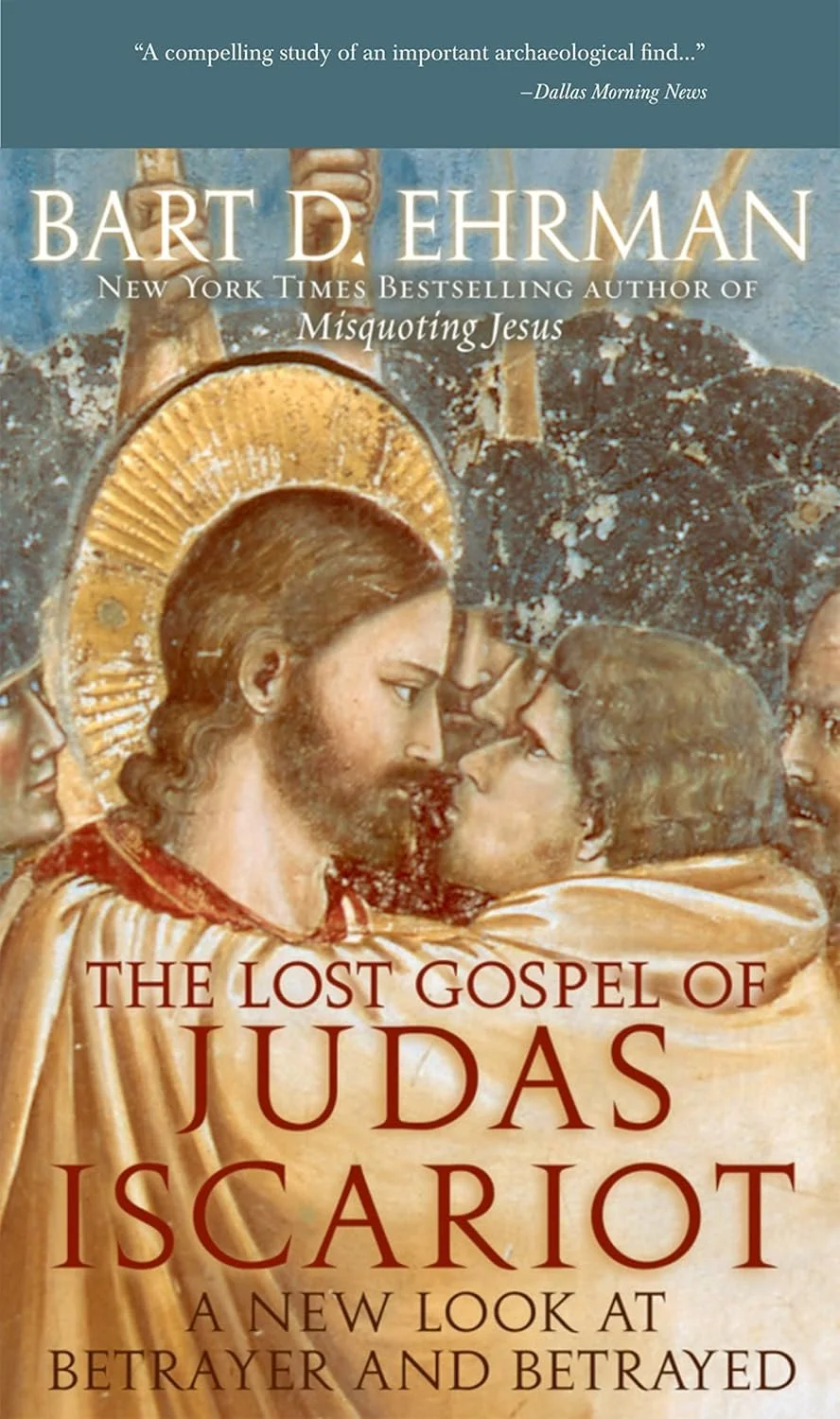
I’ve fallen into some Gnostic Gospel reading lately, particularly The Gospel of Judas. Bart D. Ehrman is an academic, and his prose is a little dry, but his is a good perspective on an outlier of a gospel.
Here’s an excerpt from the blurb:
A leading historian of the early church, Bart Ehrman, offers the first comprehensive account of the newly discovered Gospel of Judas, revealing what this legendary lost gospel contains and why it is so important for our understanding of Christianity. Ehrman describes how he first saw the Gospel of Judas—surprisingly, in a small room above a pizza parlor in a Swiss town near Lake Geneva—and he recounts the fascinating story of where and how this ancient papyrus document was discovered, how it moved around among antiquities dealers in Egypt, the United States, and Switzerland, and how it came to be restored and translated.
More important, Ehrman gives the reader a complete and clear account of what the book teaches and he shows how it relates to other Gospel texts—both those inside the New Testament and those outside of it, most notably, the Gnostic texts of early Christianity.
Finally, he describes what we now can say about the historical Judas himself as well as his relationship with Jesus, suggesting that one needs to read between the lines of the early Gospels to see exactly what Judas did and why he did it. The Gospel of Judas presents an entirely new view of Jesus, his disciples, and the man who allegedly betrayed him. It raises many questions and Bart Ehrman provides illuminating and authoritative answers, in a book that will interest anyone curious about the New Testament, the life of Jesus, and the history of Christianity after his death.
&
As I said, he’s an academic, and some of his points seem to me '“much ado about nothing,” but ome of his ideas are provocative, and well worth your perusal, and contemplation as well.
&&&&
The blurb is a little fantastical to my way of thinking. Mr. Ehrman, like all persons indoctrinated by patriarchy as the norm, is a pretzel sometimes as he contorts his theology to fit the prevailing custom. For me, I’d just as soon toss the custom, and think freely for myself, but then … I always did like Lilith better than Eve.
&
Are you waiting for a sign?
How about this one?
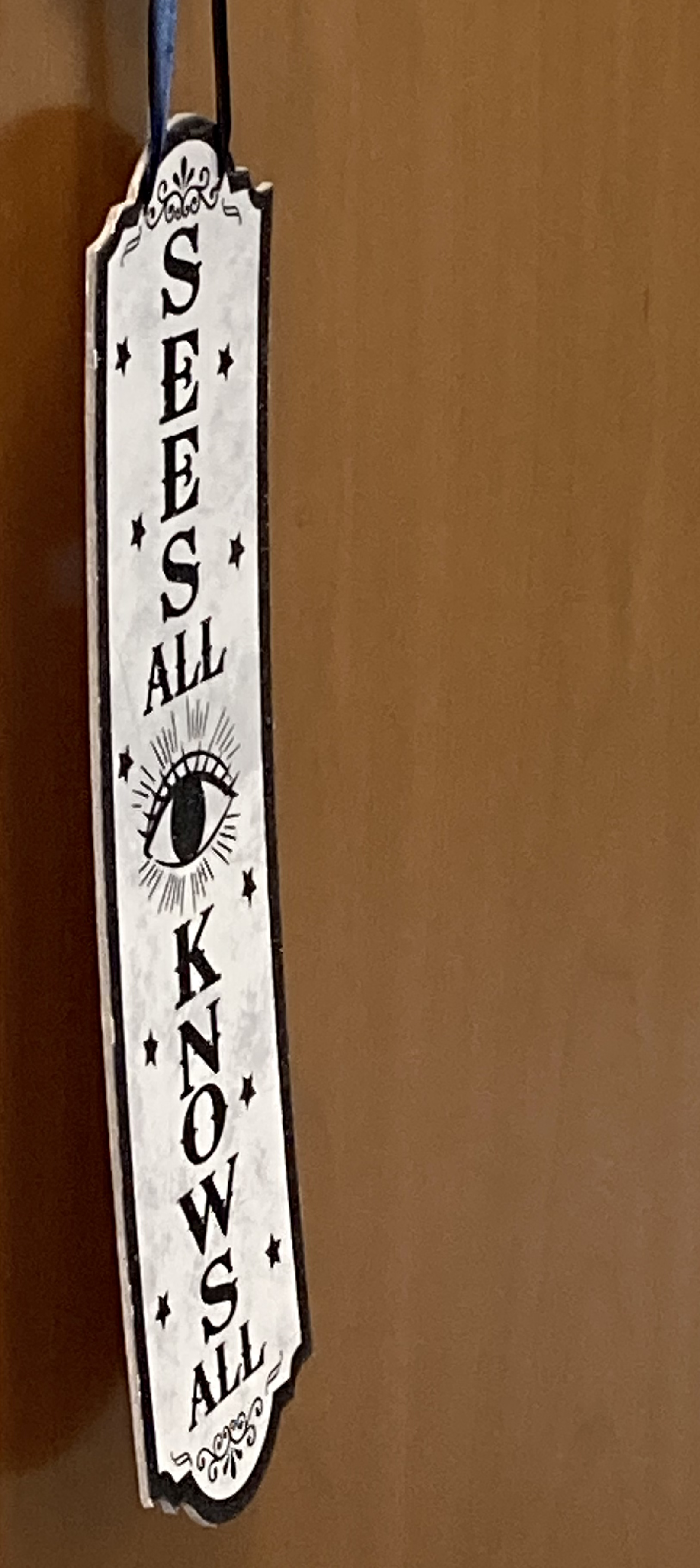
I went to the eye doctor recently,
and this sign was hanging on one of his
exam room doors.
I laughed,
but later, I thought a little more about it.
It was meant to be facetious,
of course,
but is it?
Isn’t there a part of you, your spirit,
the very best of you,
that, when you get still enough,
does just what this sign promises?
Sees All,
Knows All.
There is.
You can access this knowing
any time you like.
It costs you nothing but time.
So think of a thing that you’re fussing about.
It doesn’t matter what it is.
And get that still,
that inner,
that quiet,
that knowing.
Go to your
Sees All, Knows All,
And ask,
Belovèd.
It’s ask, and you shall receive,
not moan and you shall receive.
Ask,
and be amazed
at what all you see and know.
&
I am, without doubt, certain that And is the secret to all we desire.
Let’s commit to practicing And ever more diligently, shall we?
Until next time,
Be Ampersand
&&&&
P.S. There have been some inquiries about donations and tax deductions. Sanctuary, the organization which umbrellas all of my work is a 501(c)3, and donations are fully tax deductible. Donate here using this address via Paypal. Or send a check snail mail to: Sanctuary, 16 Van Gaasbeck Street, Kingston, NY 12401.