
Ampersand Gazette #106
Welcome to the Ampersand Gazette, a metaphysical take on some of the news of the day. If you know others like us, who want to create a world that includes and works for everyone, please feel free to share this newsletter. The sign-up is here. And now, on with the latest …
&&&&
Why We Fall for Narcissistic Leaders, Starting in Grade School

Narcissists see themselves as special and superior and put their egos above all else. So why do we keep falling for them?
We live in a period of extraordinary unrest. The result for many people is an overwhelming sense of uncertainty and anxiety. And those are fertile conditions for authoritarians who promise to restore order to chaos and narcissists who exude intoxicating levels of confidence and charisma.
Narcissistic leaders wreak havoc. Instead of adjusting their decisions based on objective success or failure, narcissistic executives get high on social praise, which emboldens them to take even bigger risks. As they bask in the glow of yes men and flattery, they’re more likely to double down on ideas that aren’t working.
Narcissists are ball hogs and glory hounds. They take credit, assign blame and put themselves above the group. They see leadership as an opportunity to seize, not a responsibility to serve.
Narcissists are not hard to spot. They boast about themselves, post flattering photos of themselves, sign their names with oversize letters. They feel entitled to special treatment—and when they don’t get it, they signal virtuous victimhood, airing their grievances as if it were Festivus. Across multiple studies, people who were well aware of narcissists’ self-serving tendencies still preferred them as leaders for an unpredictable world.
Narcissistic leaders are more appealing to people with low self-esteem. The lower our opinions of ourselves, the more insecure we’re feeling, the higher our opinions of narcissists.
Wise leaders balance confidence with humility. They’re secure enough in their strengths to acknowledge their weaknesses and learn from their critics. Whereas narcissists covet leadership roles, humble leaders are often reluctant to assume the mantle.
The responsibility of leadership is too important to entrust to arrogant people. Narcissistic leaders deny their weaknesses and make themselves weaker. Humble leaders admit their weaknesses and make themselves stronger. Great leaders overcome their weaknesses and make us all better.
Excerpted from an Essay by Adam Grant in The New York Times
“Why We Fall for Narcissistic Leaders, Starting in Grade School”
December 29, 2025
There was a girl in my fourth grade class. Lynn. She was perfect, according to the tropes of the time. Now I can see how mean she was, and that, yes, Virginia, she was a narcissist. And did I ever want to be part of her circle. Was I? Never.
When she and another girl, Jana, the blonde version of Lynn, were mean to me at my own ninth birthday party, I drew the line. Something about how they were that day made me see through the perfection to the real mean girls.
I realized a whole lot of wisdom all at once, wisdom that is to be found in the Letters to the Editor written in response to Adam Grant’s essay. Consider these ideas.
& The narcissist’s grandiosity is not confidence. It is a brittle defense, an overcompensation for fragile self-esteem shaped by early experiences of emotional neglect and misattunement. That history can leave a person deeply shamed and dependent on external affirmation, intoxicated by praise and hypersensitive to criticism. With characteristic emotional volatility and impaired empathy, meaningful, reciprocal relationships are out of reach for narcissists.
I saw their emotional volatility, and impaired empathy. Those two girls weren’t only mean to me, they were mean to some of my guests, too.
& Narcissists do not rise in a vacuum. They rise in systems under strain. When uncertainty becomes chronic—economic insecurity, relentless pace, blurred boundaries, constant performance signaling—organizations and societies become inflamed. In that state, confidence gets mistaken for competence, dominance for direction and certainty for safety.
Is it any wonder that our healthcare system is rife with diseases of inflammation? Or that what we now know as climate change started out as global warming? And don’t get me started on road rage, or the gun violence in our country. Inflammation, anyone?
& As a therapist, lawyer and mediator for 40 years, Bill Eddy wrote in his 2019 book, “Why We Elect Narcissists and Sociopaths—and How We Can Stop!” he noted that they each gained power with what he calls the “fantasy crisis triad”: a terrible (fantasy) crisis; an evil (fantasy) villain; and assuming the role of a (fantasy) hero. Then these leaders adopted fantasy policies of their own, based on no research and without initially consulting advisers.
And do you know, those two girls manufactured social crisis after social crisis in our turbulent fourth grade year! They used gossip, shunning, and downright lies to hurt students they, for whatever capricious reason, decided had to go.
& Why is America today such fertile ground for narcissistic leaders? Our national obsession with rugged individualism has undermined the belief that society has an obligation to care for its most vulnerable. When strength becomes the only virtue, when consideration of the common good is deemed a weakness, it is no surprise that narcissism prevails.
That’s when I first took note of what the Nazarene Rabbi called “the least of these,” those whose needs were greatest. That’s when I first noticed that kindness went a long way. That’s when, I suppose, I began to serve others.
All of us have narcissistic needs, Belovèd. We cannot escape them, but we don’t need to lead with them either. If we’ll tune in to our moral compasses, those internal ‘what’s right and what’s wrongs’ and live by those, we won’t lead with narcissism, we’ll start from a place of kindness and service, and go from there.
Set your intention some day this week to have a kindness and service day. Look for opportunities to practice both. You’ll find that your day is brighter, your life feels easier, and you are full to brimming of the abundance you need.
&
Curiosity softens defensiveness.
Rick Levine, Daily Astrologer for Beliefnet
1.5.26
The Question:
How can I stop feeling defensive?
&mpersand Answers:
Who knew that curiosity was such a cure-all? Do you know why that is? I’ll tell you, but first, let’s look at how we get (and stay) defensive.
Are you defensive? Is that one of your default positions? It is for a lot of us. There are also a lot of forms of defensiveness. I asked Google to tell me about some of them. Here’s the short answer:
“Defensiveness shows up as an automatic reaction to perceived criticism, manifesting as blaming, making excuses, denying responsibility, or counter-attacking, often stemming from low self-esteem or past trauma to protect oneself from shame or hurt. It blocks real connection through tactics like gaslighting, the silent treatment, or shifting focus, preventing problem-solving and fostering resentment, but it's rooted in a deep need to feel valued and safe.”
Here’s the longer one, which I deem worth our time because defensiveness wears so many disguises!
“Common ways defensiveness appears:
& Verbal Tactics: Interrupting, arguing facts, changing the subject, or escalating with sarcasm or personal attacks (e.g., "You always..." or "What about your mistake?").
& Blame & Excuses: Shifting responsibility to others, circumstances, or luck, refusing to see your impact.
& Denial & Justification: Denying something happened, fabricating stories, or insisting your intentions were good, rather than owning the impact.
& Emotional Shutdowns: Using the silent treatment, becoming completely withdrawn, or acting overly indignant as if you're morally superior.
& Playing the Victim: Agreeing but then making the other person feel guilty or that they are the problem for bringing it up.
& Physical Cues: Tight chest, increased heart rate, or hostile body language (crossed arms, avoiding eye contact).
Strangely (or not,) they all seem like behaviors I see in narcissists. How about you? Well, yes, how about each one of us, because, let’s face it, we all can be defensive.
Then along comes our trusty friend, curiosity, and all bets are off. It’s hard to be curious and defensive at the same time. Its etymological roots are Latin from to care, and there’s your secret saving grace.
It’s hard to show care and be defensive at the same time, too. Like Rick Levine said, curiosity softens defensiveness, and that’s exactly what’s needed. How? When you’re going defensive, notice something to care about, and ask about that. Watch your defensive behavior, no matter its formatting, melt away like sidewalk chalk pictures in the pouring rain.
&
Here’s a universal affirmation. It works every time, for everyone, always and forever …
&

Alright, we finished it. I had a few global changes that still needed some attention, but they were swiftly fixed. Then I realized that I had used a quote from Dr. Seuss in the book.
So, yeah. You can’t really do that without asking permission, and usually paying some sort of fee. In this case, I need nineteen words from Happy Birthday to You!, which, believe it or not, was written in 1959. I’ve written to Dr. Seuss, which was fun as the email for inquiries is drseuss@drseuss.com. Perfect, no?
Anyway, I realized that I had to be prepared for a yes, which would be ideal, or a no, and what would I do if I got a no? Good question. I’ve decided I’ll write my own verse in anapestic tetrameter, just like he did. No big. I even dreamed a line or two of it.
This got me thinking that no matter what, when I encounter a no, when it comes to my novels, I just use another kind of creativity to solve the problem. This must be why I like writing them so much. Each one is a challenge in its own right.
I’m still thinking of starting this book off in a different way than I ever have before—on my YouTube Channel, reading a couple of chapters a week. No, not the perfect of an audiobook, instead the imperfect of a bedtime story read aloud.
I’m still inputting the edits of the final book of The Subversive Lovelies. It’s called Jaq Direct. I have maybe another week or two of behind the scenes work. Then we’ll read it, proof it. Then poof! That whole series is complete.
Please make this indie author happy? Choose one of my series, and read all of them. Then review all of them. That’s the way others find books.

&
Special Request:
Send me your spiritual questions please. You may do so anonymously, or I won’t print names, etc. As of now, I’m posting &mpersand Answers twice a week.
&
I’m a retreat widow this weekend, and I thought you might like to know about this wonderful thing Tony does. Starting Friday night and going through Sunday noon, he’s working with two poets who love to go on retreat together, but need a container for their work so they stay with it.
They’re on their own in a quiet retreat-y-type place in the South. Tony’s here. They’re zooming. These particular two have been doing retreats with him for many years, sometimes twice a year, a weekend at a time.
At the end of their retreat weekend, both will have … written a lot of new material, gone through and evaluated a lot of recent poetry, and have a plan for where they’re going next on their poetry odysseys.
Do you need a writer’s retreat? Each one is unique to the needs of the writer/s. Find Tony Amato, who has been both attending and creating and running writers’ retreats for more than thirty years, here.
If you’ve got a book or a poem, or a book of poems, or a radio program, or a novel, or a series, or a memoir, or any form of writing cooking for 2026, I know a guy who is an immeasurable help. Seriously, this is the guy. He’s edited my books for more than 20 years, so I ought to know. Find him here. Oh, and here’s his substack Subscribe here.
&
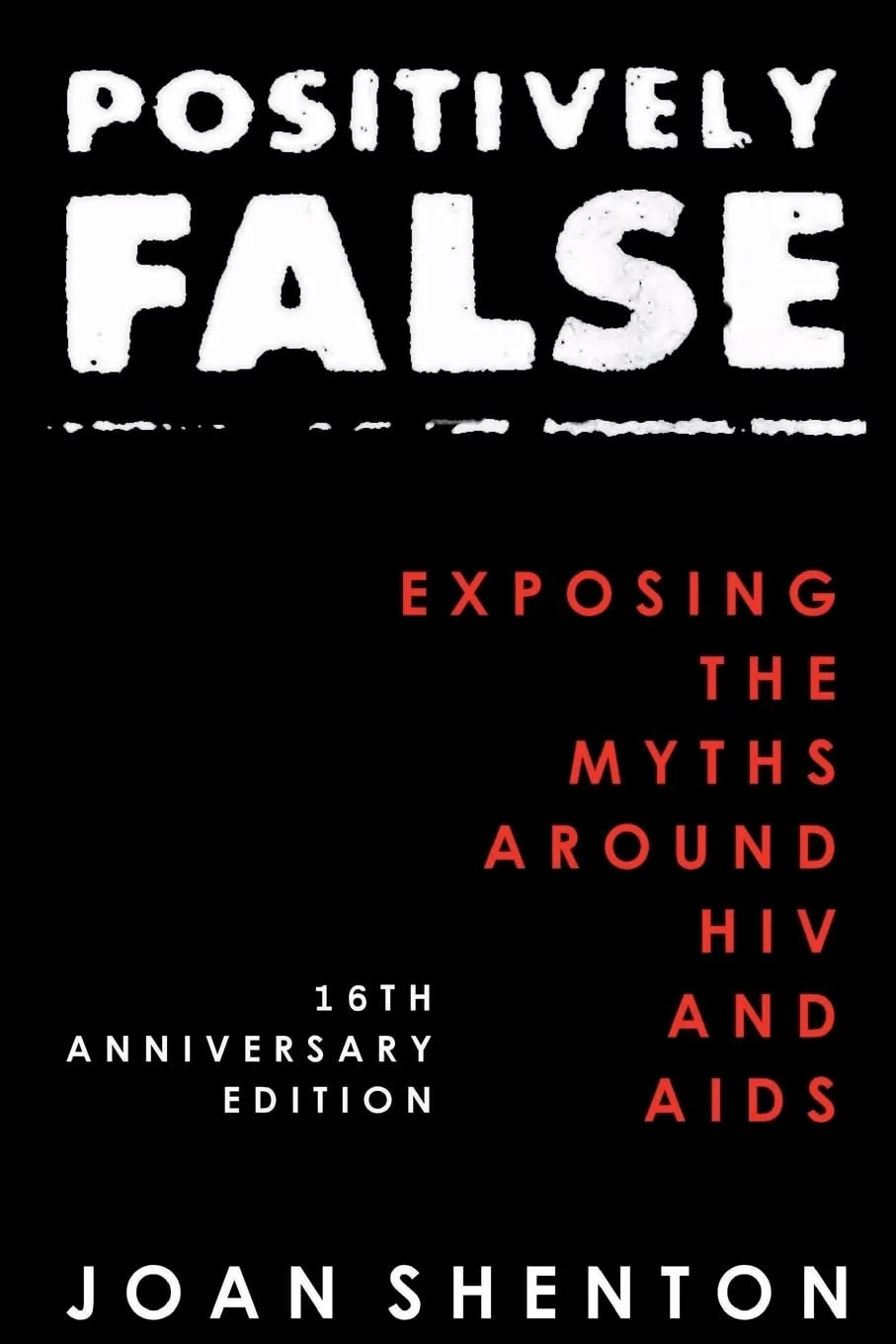
As part of my HIV/AIDS research, I am reading Positively False: Exposing the Myths around HIV and AIDS—16th Anniversary Edition by Joan Shenton
Here’s what the blurb says:
“In the 30 years since 'HIV' was announced as the probable cause of AIDS we are no closer to a vaccine or cure. Scientists and clinicians who question the widely held belief that 'HIV' is the cause of AIDS hold fast to their position that multiple factors can be attributed to the illnesses defined as AIDS which continue to afflict specific communities and risk groups, and that billions of dollars and millions of lives have been wasted over a retrovirus that is either harmless or may not even exist. This 16th Anniversary Edition of Positively False: Exposing the Myths around HIV and AIDS from award-winning tele-journalist Joan Shenton features the original late 1998 text with updates and contributions from 20 journalists, writers, scientists and clinicians who present critical arguments challenging the current scientific orthodoxy. They include Henry H. Bauer, Christian Fiala, Neville Hodgkinson, David Crowe, Celia Farber, John Lauritsen and David Rasnick. Also features the script of the 2014 documentary Positive Hell and renowned molecular biologist and pioneering critic Peter Duesberg et al.'s withdrawn 2009 paper for Medical Hypotheses.”
Lord have mercy. In all seriousness, I knew that there had been a passel of shenanigans, some of it not-so-nice, around HIV and AIDS, and the medical-scientific-pharmaceutical-political industrial complex, but this book is opening my eyes in a way that’s downright shocking. The sheer cruelty in the face of the devastation of the beginning of the AIDS epidemic is legion, and terrifying. No wonder I want to rewrite its story!
&
Are you waiting for a sign?
How about this one?
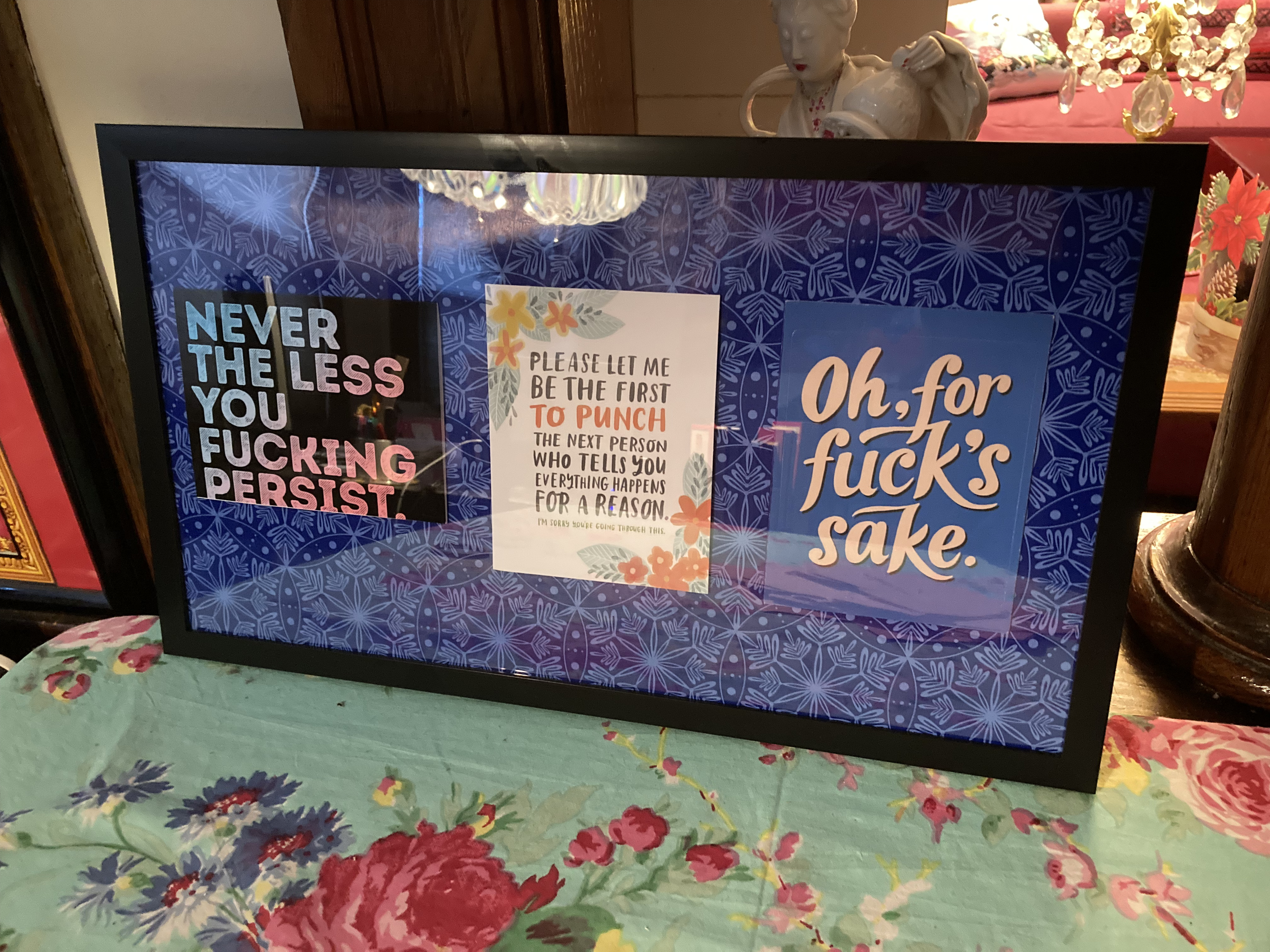
At the risk of offending you
with colorful language,
I just had to share
these three cards
from a dear friend
that I received
over the course of three
hospitalizations
this past fall.
I had to frame them.
Had to.
Because they were too perfect not to frame,
and because they said it all.
Generally,
humans don’t deal well with illness.
And don’t get me started
on Death and Dying.
But my friend did.
She kept it totally real.
And every time I opened a card from her,
I laughed,
which I SO SO SO needed
to do whilst I was
(and still am a bit)
struggling with juggling
all this medical rigamarole.
Have a think about the last time
you were ill, or someone you cared about was.
Did you keep it real?
Can you next time?
Here’s a heartfelt wish
for blooming good health
for you, and all those you love,
in 2026.
&
I am, without doubt, certain that And is the secret to all we desire.
Let’s commit to practicing And ever more diligently, shall we?
Until next time,
Be Ampersand