
Ampersand Gazette #102
Welcome to the Ampersand Gazette, a metaphysical take on some of the news of the day. If you know others like us, who want to create a world that includes and works for everyone, please feel free to share this newsletter. The sign-up is here. And now, on with the latest …
&&&&
Pilgrimage
Once you put people into categorical boxes, you are inviting them to see history as a zero-sum conflict between this group and that one. Today we live in a political, cultural and religious war between two impoverished armies.
On the one side are the Christian nationalists, who practice a debauched form of their faith. Christian nationalism is particular rather than universal. It is about protecting “us” against “them”—the native versus the immigrant. It is about power more than love. It is about threat more than hope. It is rigid and pharisaical rather than personal and merciful.
On the other side are the exhausted remains of secular humanism. That humanism started out trying to liberate people from dogma, but it has produced societies in which people feel alienated, naked and alone. It has failed to formulate a shared moral order that might help people find meaning and solidarity in their lives.
The passions of the heart precede and are greater than the machinery of reason. Whether your language is spiritual or scientific, the bottom line is that the energy that animates the world emerges from the human depths, from the mysterious regions where passions form.
Seen in this light, we’re not warriors clashing, we’re sojourners exploring. Each of us start with our own foundational truths—Christian, Jewish, rationalist, whatever. Each of us is swept along by the currents of our own traditions. But each of us longs to grow, to become better versions of ourselves, and hopefully we help one another along our parallel and intertwining pilgrimages toward a horizon that we will never reach—at least in this world.
We’ve been trained, though, to think in battleground metaphors, but if we’re going to get out of this nasty age of ours, we’re going to have to see the world through pilgrimage metaphors instead. In the Book of Exodus, Moses asks to see God’s face, but God shows him only his back. Perhaps that because you don’t see the face of one you are following.
Harvard psychologist Dan Gilbert once observed that human beings are works in progress who think they are finished. But people who see themselves as pilgrims know they are unfinished; they know they are still on a journey that will change them. They embrace the dynamic, forward flowing nature of life.
I now see glimmers of a better way to be faithful in the world. St. Augustine advised us to follow what seems delightful, and in this pilgrim’s way of living I see the delight of pluralism. The world is too complicated to have all its truth encompassed by any single tradition—by Christianity, Judaism, Islam or Enlightenment. You can plant yourself in one and learn from them all.
I see, finally, a glimpse of the America I thought I knew. For centuries we have been a hopeful people, a people on the move, defined more by our future than our pasts. When people have said: I want my heart constantly enlarged, my nation constantly moving toward fairness. Eventually Americans, restless as any people on earth, will want to replace threat with hope and resume our national pilgrimage.
Excerpted from an Essay by David Brooks in The New York Times
“How to Replace Christian Nationalism”
November 13, 2025
I’d never heard the words “Christian Nationalism” until very recently. I was a child in the sixties, not of the sixties. By then, those two words had gone underground.
So had the other two Mr. Brooks cites: “Secular Humanism.”
What I want us to consider is what’s between, underneath, and above the two poles.
Let us be clear. Neither is right. Neither is wrong. Both are … limited in their viewpoints, and in their daily living.
The field out of which all religiosity grows is the wealth that allows one to choose one’s beliefs.
The field out of which all philosophy grows is the wealth that allows one to choose one’s frameworks.
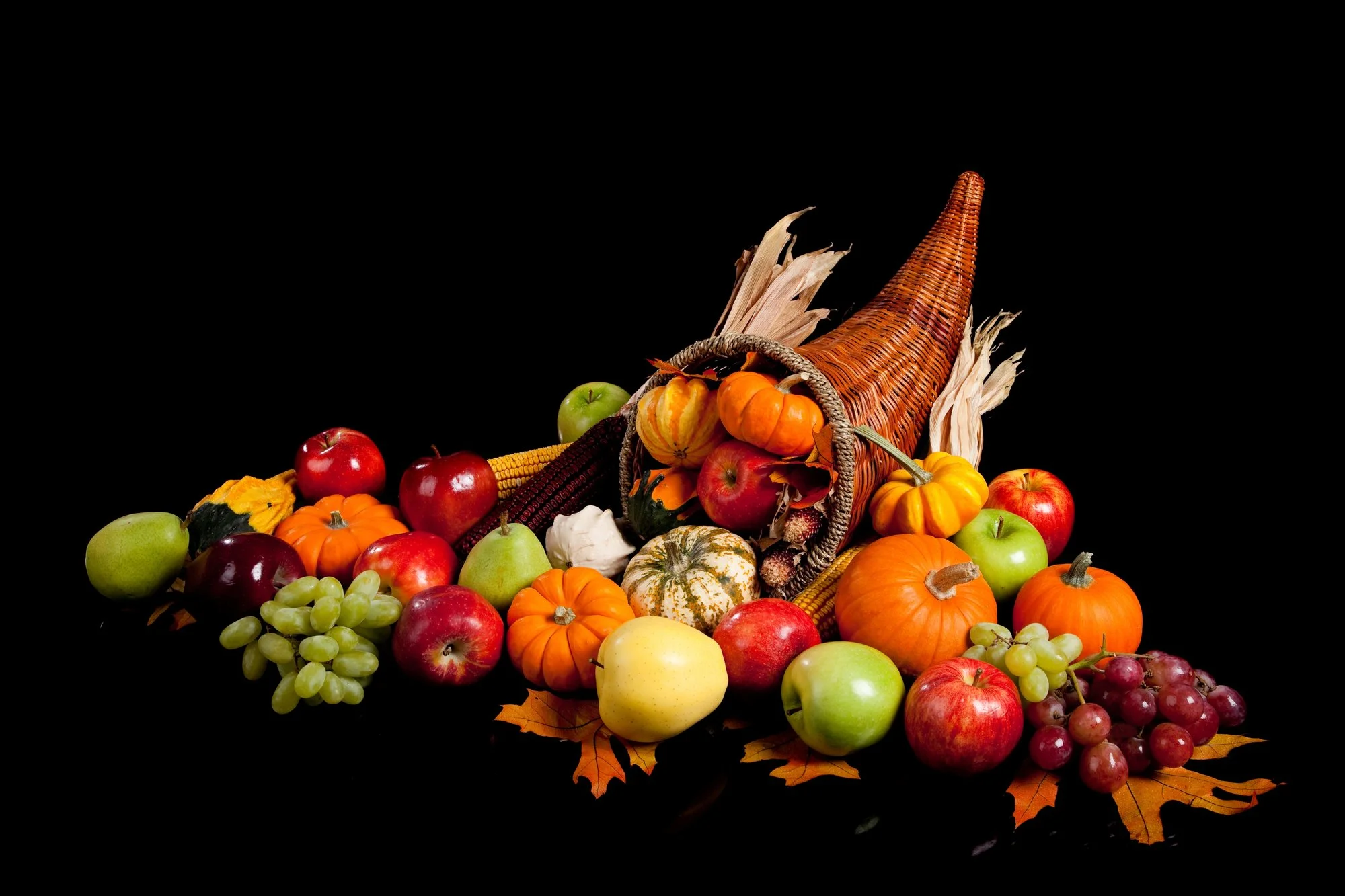
Both come from wealth, hence the cornucopia of the image above. (It’s mere convenience that it is also associated with American Thanksgiving.)
We are not trained to see any of these things this way.
We are trained, instead, to compare, and to compare is to measure, and to measure is to project quantitative judgment upon anything and everything before allowing whatever it is just to have its own existence.
None of these things in themselves are bad, but in the sequence we use repeatedly, they can have wretched consequences.
So let’s take the rabbis’ path, and go backward to go forward.
Look at the field before you choose the beliefs. Look at the field before you choose the philosophies.
If you’ll stay with the field, no matter what beliefs you choose, you will stay with the wealth that is the birthright of every soul everywhere everywhen forever and ever, Amen.
If you lose sight of the field, you lose your birthright, which is where we are now.
There is only one requisite for each one of us to stay with the field: M.Y.O.B.
And no, you did not read me wrong: Mind Your Own Business.
The minute you decide it’s your right to mind my business, you lose your wealth. The reverse is true for me: when I decide to mind your business, I lose mine.
Whyever in a million, squillion years would I want to do that?!?!?
I wouldn’t.
Would you?
So, as we approach Thanksgiving week, despite its horrid antecedents, let us all be reminded of the wealth that is naturally our own as long as we mind our own business. If we succeed at this, even for seconds at a time, it ought to make Thursday a whole lot more fun.
Oh, and change the world completely for the better.
&
How to Stop Being So Hard on Yourself

We can be our own harshest critics. Practicing a little self-compassion, though, goes a long way. When people go through challenges or stressful situations, those who display more self-compassion are more resilient.
What is self-compassion?
Self-compassion is the process of expressing support, warmth and understanding toward yourself during difficult times—and recognizing that you aren’t alone in your imperfections.
It arises from mindfulness, which involves staying focused on the present moment without judgment. Self-compassionate people can identify when they are feeling defeated or inadequate, but avoid becoming lost in those feelings so that they can respond to themselves with kindness.
What are the myths about self-compassion?
One common myth is that self-compassion will undermine motivation to improve yourself or your circumstances. But research suggests that support, encouragement and constructive criticism are more effective motivators than negative feedback.
Another myth is that self-compassion is self-indulgent.
Finally, self-compassion is sometimes confused with self-care, but it’s not just about soothing.
Self-compassion “is the empowerment to be yourself, to feel what you’re feeling, fully and without needless defense.”
How do you develop self-compassion?
Say kind things to yourself every day.
The vast majority of people are significantly more compassionate to others than they are to themselves.
Take a compassion break.
Tara Brach, a psychologist and the author of “Radical Acceptance,” suggests the RAIN method: Recognize, allow, investigate and nurture.
Pay it forward.
Show them that they’re not alone. We need people who are more self-compassionate and compassionate toward others.
In this sense, self-compassion can be fierce and strong: Think “mama bear” energy.
Excerpted from an article by Christina Caron in Well in The New York Times
“How to Stop Being So Hard on Yourself”
June 4, 2025
Compassion has become one of those self-talk, self-care buzz words. But no one likes to talk about what it is. It comes from Latin roots meaning to suffer with.
When you’re being hard on yourself, are you suffering? Let’s start there.
A lot of this depends upon the motivational model you grew up with.
Did your family of origin encourage you? Discourage you? Shame you? Support you? Did they use disappointment as a weapon (my mom’s favorite)? Did they cheer you on?
What did you learn about motivation, and especially self-motivation, in your family?
I can tell you this: waving the I’m-so-disappointed-in-you card at me does bupkis.
Instead of buzz-wording on compassion, let’s try this a different way. When you know what you learned at home about how to be motivated, then figure out what motivates you now.
It could be identical or completely different.
Now, let’s add in a huge ol’ dollop of old-fashioned kindness.
When someone other than you is in the dumps, for whatever reason, what do you offer them? Usually it’s some form of kindness.
What do you need right now? is a great question.
Sometimes a person needs a tantrum. Invite them to go to it as long as you’re in a safe place. Or they need to tell someone off. Or they need to hit something. Or laugh like a crazy person. Or eat ice cream. Or say every bad word they’ve ever known.
What do you need right now?
Understand that so much unhappiness in this world of ours is deep, long-term, and so far from a one-and-done model that it’s a joke to invoke one.
Now, what do you need this week? Today? For the next month? How can I help you with that?
Most often kindness breaks down what feels insurmountably big into smaller, bite-sized pieces. Sure, okay, you want to win the Nobel Peace Prize. Me, too. But how about we start at Saturday’s peace rally?
In “Auld Lang Syne,” one of the final lyrics is … “we’ll drink a cup of kindness yet.”
That’s how you become self-compassionate. Drink a cup of kindness, Belovèd. FWIW, I happen to know that the Earl of Grey is particularly effective.
&
Here’s a universal affirmation. It works every time, for everyone, always and forever …
&

I’m still very much in recovery mode from the last trip to the hospital, but getting better fast. A special infusion to goose hemoglobin production has made quite a difference, as has my trusty exercise bicycle. Now onto writing news …
Impending Decision, the fifth Boots & Boas Romance, is live as an ebook and in print on Amazon. If you’re a butch-femme romance fan, there are five of them so far, and a great binge for Thanksgiving weekend.
I am excited to report that Tony is almost halfway through editing the final book of The Subversive Lovelies. It’s called Jaq Direct. Once he’s done, I’ll input the changes, and we’ll proof it aloud.
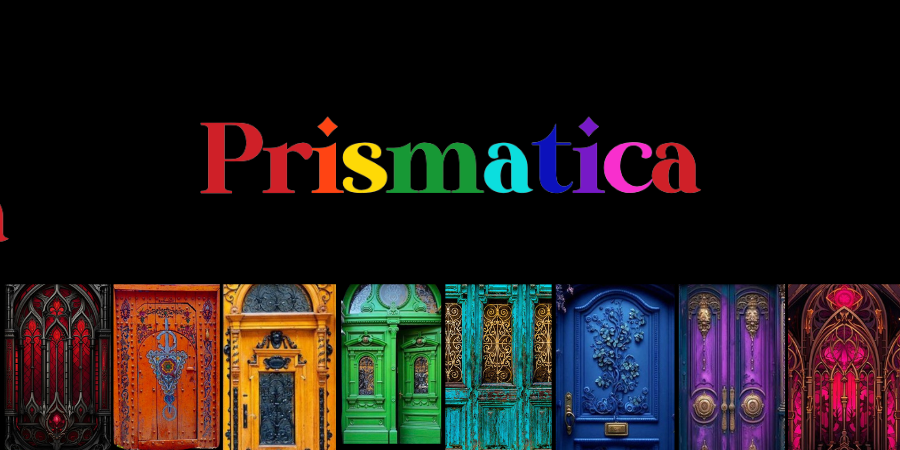
In addition, I’ve had the first Prismatica book queued up for an edit and publication. Its title is Besieged. The series is a paranormal retelling of the AIDS crisis in which, for a change, humanity does the right thing instead of the wrong one.
It’s been long enough since I wrote the draft, and read it, that it feels brandy-new, and very fun to dive back into those particular characters. I still both like and dislike the same ones. Soon enough, this will be in the proof-reading queue.
Please make this indie author happy? Choose one of my series, and read all of them. Then review all of them. That’s the way others find books.

&
Special Request:
Q & A
I have another thing about writing I want to run by you. It keeps coming to me in guidance that I need to be writing a spiritual advice column. Answering questions people have. Certainly, I would say I’m at my best as a teacher with Q & A.
I’d like it to be written, and am willing to do a YouTube version, but I need your questions first.
It seems to me that the thing most of us have trouble with is applying what we know. Mostly, we know what spiritual principles appertain in any situation, but how do we use them for the highest good?
Send me your questions, Belovèd, and I’ll start.
&
Books, well, my books, but also books in general, seem to have their own cyclical rhythms in the everyday world. I go through wild times of creating, wherein I’m not even really totally present on the planet, but instead am mostly in whatever book I’m writing.
I’m a discovery writer, so I start at the beginning, and write till I come to the end, and then stop, to borrow from Alice in Wonderland. In the interim, I don’t know where the story is going. Those are the times Tony and I have fascinating lunch conversations.
I run new ideas by him—and remember, just like Hollywood, we’re reading aloud whatever I’m writing daily, so he’s right with me in the process—and things get distilled so I am prepared to write like a fiend after my daily nap.
I’m just describing one writer’s process. Everyone’s is different. Everyone’s. And Tony has the uncanny ability to show up for any kind of creative process. As a result, I cannot recommend him enough. If you’ve got a book cooking for 2026, I know a guy who is an immeasurable help.
Seriously, this is the guy. He’s edited my books for more than 20 years, so I ought to know. Find him here. Oh, and here’s his substack Subscribe here.
&
I’ve gone back to research reading.
YAY!
So thrilling.
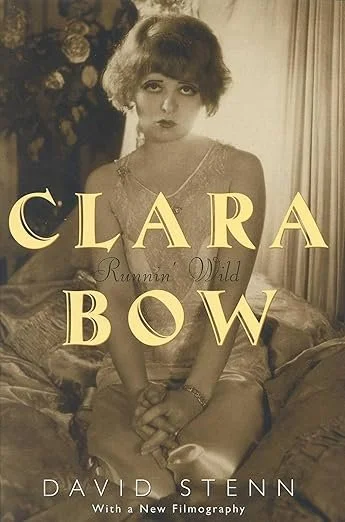
Right now I’m reading: Clara Bow: Runnin’ Wild By David Stenn
Here’s what the blurb says:
“Hollywood's first sex symbol, the 'It' girl, Clara Bow was born in the slums of Brooklyn in a family plagued with alcoholism and insanity. She catapulted to fame after winning Motion Picture Magazine’s 1921 “Fame and Fortune Contest.” The greatest box-office draw of her day—she once received 45,000 fan letters in a single month, Clara Bow's on screen vitality and allure that beguiled thousands, however, would be her undoing off-camera. David Stenn captures her legendary rise to stardom and fall from grace, her success marred by studio exploitation and sexual scandals.”
I’ve always had a “thing” for her—she’s a fellow redhead, after all. Rough and tumble, she started out life as a tomboy and became one of the most famous women in the world because of the motion picture industry. Clara Bow knew how to do realism at a time when acting wasn’t meant to resemble the real in the least.
Clara Bow’s story is riveting, and sad—oh my God—weeping on the exercise bike sad. She was used and abused by the Hollywood studio system in ways unimaginable, and she captivated audiences all over the world. So will this well-told tale.
&
Are you waiting for a sign?
How about this one?
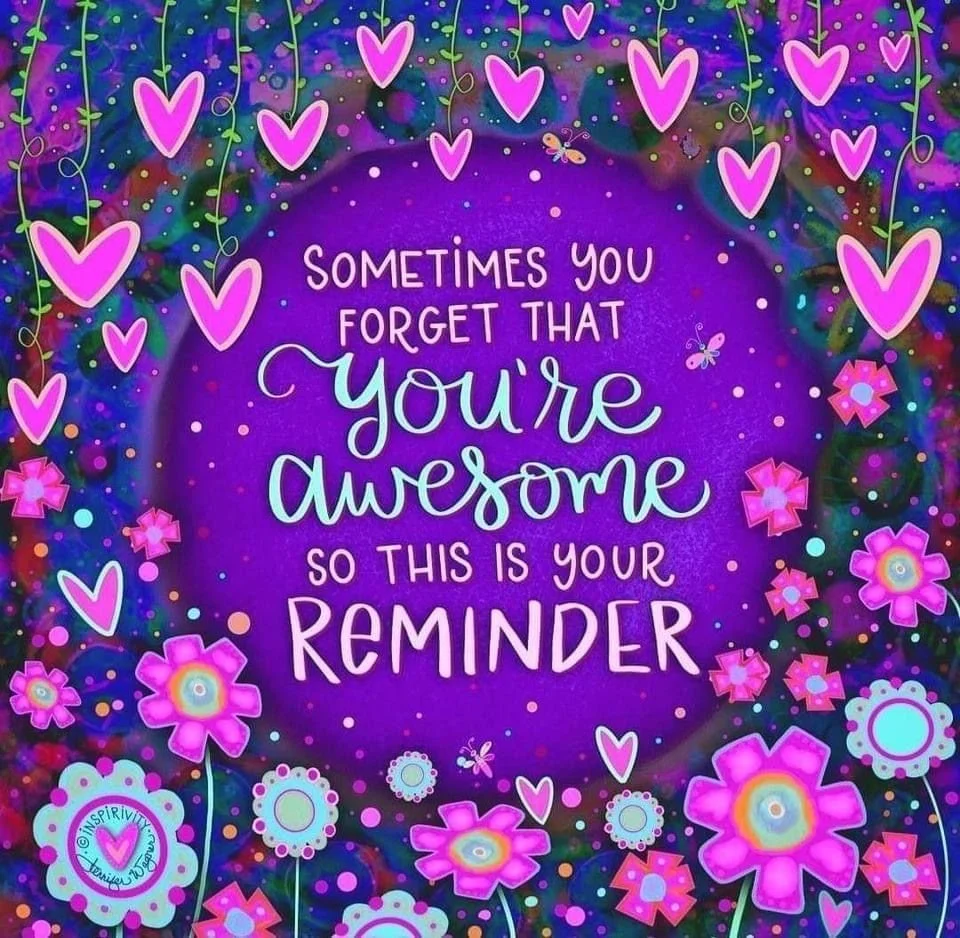
How do you suppose your life
might be different
if you actually thought you
were awesome?
I’m not kidding, not really.
Would that change how you
thought about yourself?
About others?
About the world?
Would it change how you behave?
Would it change your beliefs
about yourself?
I’m betting it would.
I double-dare you:
take one day and be awesome
all day.
See what happens.
&
I am, without doubt, certain that And is the secret to all we desire.
Let’s commit to practicing And ever more diligently, shall we?
Until next time,
Be Ampersand