
Ampersand Gazette #123
Welcome to the Ampersand Gazette, a metaphysical take on some of the news of the day. If you know others like us, who want to create a world that includes and works for everyone, please feel free to share this newsletter. The sign-up is here. And now, on with the latest …
&&&&
The Greatest Story Dolly Parton Ever Wrote Was Herself
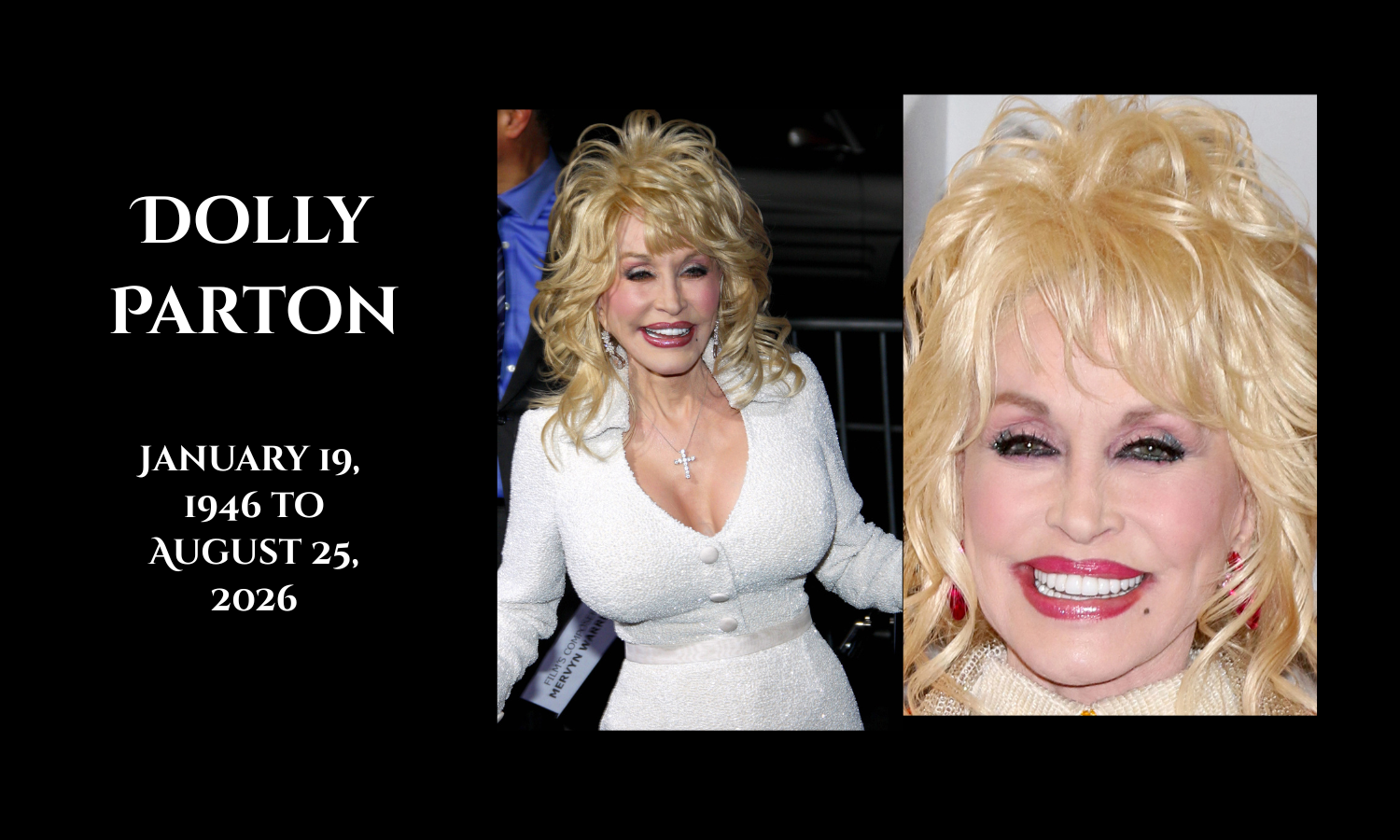
Loving Dolly Rebecca Parton was easy. She was beautiful, funny and kind. Rumor has it that she was a prankster who could tell a good dirty joke. She was a country music original, a glittering pop star, a scene-stealing actress, a cultural icon and an unparalleled humanitarian. By the final decade of her 60-plus-year career, loving her had become something of a public sacrament. But Dolly didn’t see herself as a saint; she identified as something we needed even more: a writer.
Despite the way we all loved Dolly, I don’t think that many of us ever really understood that about her. We hung on to the stories she told us about how she grew up with a lot of love and not much money. We knew that she revered her father and honored her mother. We knew she told Elvis Presley he could not own the rights to one of her songs and that, amazingly, the King didn’t seem to hold it against her. We knew that she wanted kids to read and queer people to be celebrated and country people to feel seen.
She told these stories so often and with so much authenticity that most of us don’t realize these are the only stories that she really told us about herself. It was the repetition over 60 years, albeit in different registers, with different deliveries, that made her endlessly beloved yet dazzlingly impenetrable. It’s a good writer’s sleight of hand.
To understand Dolly, you have to read her as a writer. Writing her own story was the most radical, precise way to define herself in a world that kept trying to fit her into a box. She was not simply Southern, not simply country. She was from Appalachia—a place that is just as mythologized, mocked and misunderstood as Dolly was.
The story Dolly wrote about herself across thousands of songs and performances and books was a counternarrative about Appalachia. She narrated it as a place filled with soaring mountains and narrow hollers, geological wonders and distinctive cultures, abundant love and generational poverty.
When people underestimated Dolly for looking like “the town tramp,” as she put it, she embraced it. Make fun of her cleavage? You better tell a funnier gag than one she already told about herself. Want to look down on her about being parochial? You will have to square that with her outstanding business acumen. At a time when women and poor people signed away their intellectual property for a shot at stardom, Dolly started a series of successful publishing companies to retain her rights.
That’s not to say that Dolly’s pride, especially in her craft, didn’t shine through. Her indefatigable sense of herself as a creative person, with the right to make her art as she saw fit, came from her sense of place. She crafted stories in the rhyme, meter, poetry and politics of Appalachia.
For all her sparkle, Dolly was a simple girl. She wrote simple lyrics, simple melodies, told simple stories about simple human experiences. Her lyrics were simple because the living in Appalachia can be so hard. They were often radical for the same reason. Brevity is wit when men do it. When women do it, we’re supposed to think of it as luck. But for Dolly, it wasn’t luck; it was simply the truest expression of the homeland she never, not once, not even after she became a millionaire, spurned.
She knew what I know: Appalachia’s food, its literature and its music are universal. But good writing doesn’t have to imagine everyone. It only has to imagine the truest thing about all of us, that exists in each of us.
Before Dolly was a saint, when she was still just a popular twangy pop star in a wig, I saw something in the way she took up space that called to me, an ambitious girl the world did not expect much from but who knew—just knew—that she was a writer.
Dolly owned her right to write our American story. That was bigger than the hair and the boobs, shinier than the sequins, more feminist than a thousand burning bras, more honest than almost anyone gets to be in public life without selling a pound of flesh.
Dolly’s songs will live on. They document American history through the eyes of Americans who don’t often get to tell their own story. She also left a legacy for little ambitious girls. All races. All walks of life. The way she lived and worked, the way she sparkled and demurred, the way she took up space and took the hits for being larger than life is proof that a good story can change the way we see the world.
Dolly Parton was a writer. In the end, Dolly Parton is the greatest story that Dolly ever wrote.
Excerpted from an Opinion Essay by Tressie McMillan Cottom in The New York Times
“The Greatest Story Dolly Parton Ever Wrote Was Herself”
August 27, 2026
I’m a relatively new fan of Dolly’s, and still, her death at age 80 hit my heart hard.
Reading Tressie McMillan Cottom’s heartfelt words about the permission slip that Dolly was for her resonated loudly with me. I too looked for permission to be a writer.
Surely Dolly counts as one. So did another icon who left us recently, Gloria Steinem.
Dolly is famous for, among other aphorisms, saying and living, “Find out who you are and do it on purpose.” The “town tramp” was the most glamourous woman Dolly had ever seen, and she wanted glamour. So she did glamour. Her way.
There are a whole lot of reasons to admire Dolly Parton, but I think the most important of them is that she found out who Dolly was and she did that on purpose. Every minute of every day, never losing sight of her values, or her roots, or her family, or her talent, or her faith, or her love.
Net-net, Dolly Parton exuded love wherever she went with whomever she spent time, no exceptions. It’s a worthy legacy for each one of us to consider in our own lives.
Dolly’s through-line in her life was her writing. I can relate to that because so is mine. What gift did Dolly leave for you?
&
She never allowed herself to be a part of a story
of which she was not the author.
Written in The New York Times about Dolly Parton the day after she died.
The Question:
How can I remain the author of my own story?
&mpersand Answers:
Interestingly, whether it feels like you’re the author of your own story or not, you are. The issue here is: how do you write your story?
The answer is simple: through your choices. Every choice you make is an author’s choice. Take it from someone who has written over forty books.
When I decide to put Bertie and Miranda in a scene in Prismatica, then Cornelia and Guy aren’t with them. It’s a choice for my story. Now these happen to be characters in a book series, but it’s identical in your own life.
If you go to lunch with Mary, you’re not going to lunch with John. See? Turkey or ham? See? Your choices. Your simplest choices.
Now the next part of this authorship business is: who are you collaborating with? And are you happy with the collaboration? If so, great. If not, make another choice.
Choice, Belovèd, is never-ending in this life. Each one leads to the next one. And it’s meant to be this way!
The amount that others influence your choices is totally up to you. You get to choose your collaborators. You get to choose everything in your life.
So, if there are parts of your life that you don’t like, great! Choose again. Wait for those consequences, and choose again. You keep the sense of authorship when you make your choices deliberately, consciously.
&
Here’s a universal affirmation. It works every time, for everyone, always and forever …
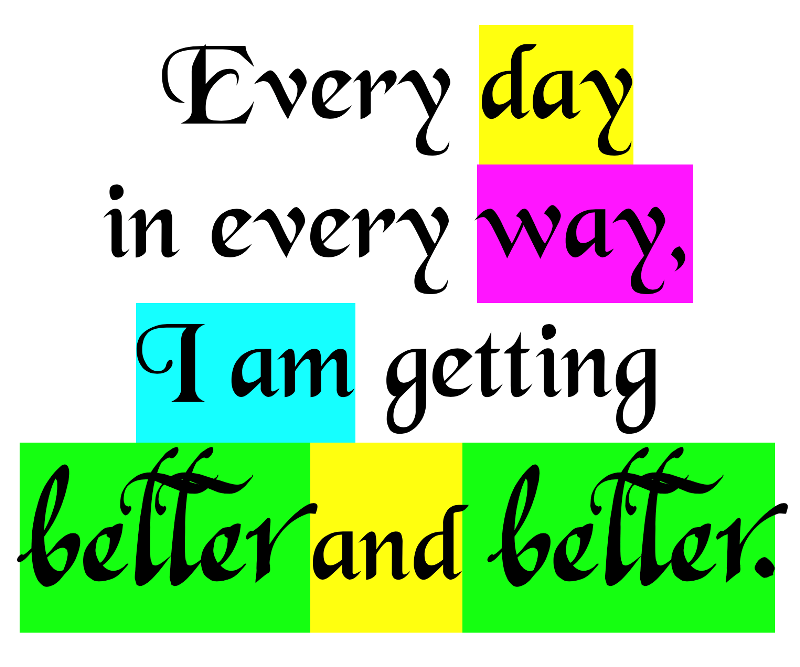
This statement is allegedly the first published affirmation. It was written by French psychologist and pharmacist Émile Coué.
&
Wow. This book is taking me places I never, ever thought I’d go when it came to fiction. There’s no accounting for obedience. Yes, you did read that right. I wait for guidance whenever I’m writing. I’ve learned the hard way that if I don’t, I have to trash whatever I produce. Well, that’s a no-brainer. I wait for guidance, because I have a severe, anaphylactic allergy to wasting my time.
But it’s not always that easy, or not as easy as typing out the instruction. The doing of it can be fraught, especially if I think I know where the plot needs to go. Still, you’d think after more than forty books, I’d get the hang of it, and I have, when I pay attention. When I don’t, you don’t want to know.
So after I did the theological research I needed, I sat down to write and what came out onto the page startled even me, and I was there! Writing it! In the moment. After that, I realized I’d come to the point where I’d lost the days of the week, so I had to reread all hundred-and-eighty-some odd pages.
Happily, I hadn’t really lost the timeline. Instead, this book goes back and forth between Earth time and Cosmic Time, so the days of the week really aren’t that important. The important thing is that I stick to the HIV/AIDS story in 1983, which would be exceedingly different in a mere two years.
I’m sure you can imagine that I’m having a lot of fun writing this one.
I knew, from the moment I walked into the audition, that the part was mine. I’d quit acting, or really, the desire to be a professional actor years earlier, and I always said that the only role I’d break my rule for was Kate. Well, I nailed the audition and got the part. Mostly, I learned my lines at traffic lights while driving from pastoral visit to pastoral visit. It was a hoot.
Mex, or maybe Taming of the Shrew, is still calling me. I’m looking forward to the first Mex written about a play, and not a musical, per se, although, as I said last time, there is a Shrew musical called Kiss Me, Kate. I don’t know it well, and what I know of it, I really don’t like … and I LOVE the play.
Mex Book Eleven takes place during the Covid-19 shutdown. Anchored in an all-female production of Taming of the Shrew presented by the residents of a safe-house shelter, it addresses intimate partner violence. The spiritual healing modality is the use of mandala.
I mostly like Shrew because so many scholars consider it a “problem” play. If you happened to read any of the comments on the all-female production done a few years ago in Central Park, you’d know what the “problem” is. Our modern eyes call how Petruchio treats Katerina abuse. Was it? I’ll have to write Shrew This! and you’ll have to read it to find out!
&
Please make this indie author happy. Choose one of my series, and read all of them. Then review all of them. That’s the way others find books.
You could start with The Mex Mysteries … the first one is Oklahoma! Hex, and it’s free. There are eleven of them so far, please, be my guest! Oh! And it’s still on the Metaphysical Bestseller List!!!
Or maybe your cuppa is one of the five butch-femme romances in Boots & Boas, which is an ongoing series with many more planned. Or, you could try The Subversive Lovelies—the stories of four siblings in the Gilded Age who just cannot manage to follow the rules! This series is complete.
There’s always the option of starting with one series and reading them all! That’s what I do when I fall in love with an author.

&
Pop singer and Broadway author Sara Bareilles in a recent article about how she faced a terrible grief said, “I feel more empowered with less artifice. Just telling the truth is really the only thing I’m interested in.”
Telling your truth is really the only thing my favorite editor Tony Amato is interested in, too. Helping you tell your truth. He has a magical ability—a musician might call it an “ear” for truth in an author’s voice. In all the years he’s edited my books—now more than twenty—I’ve never seen it fail him.
As an author, however, I’ve seen my own courage fail me, sometimes big time, and Tony has always caught me and, even better, brought me back to the truth I so dearly want to be telling. There’s even a truth-telling aspect to fiction, believe it or not. The author wants very much to be true to the spirit of their narrative.
Tony Amato is an editor committed to the truth of your voice, and he is uncompromising. Once he hears it, and helps you hear it, too, he’s completely present to maintaining that truth. If you stray, he helps you steer back to that true voice.
When you know you need that kind of advocate, I happily introduce to you Tony Amato. As Leah from Boots & Boas would say: I know a guy. This is the guy, for real. Find Tony Amato here.
&
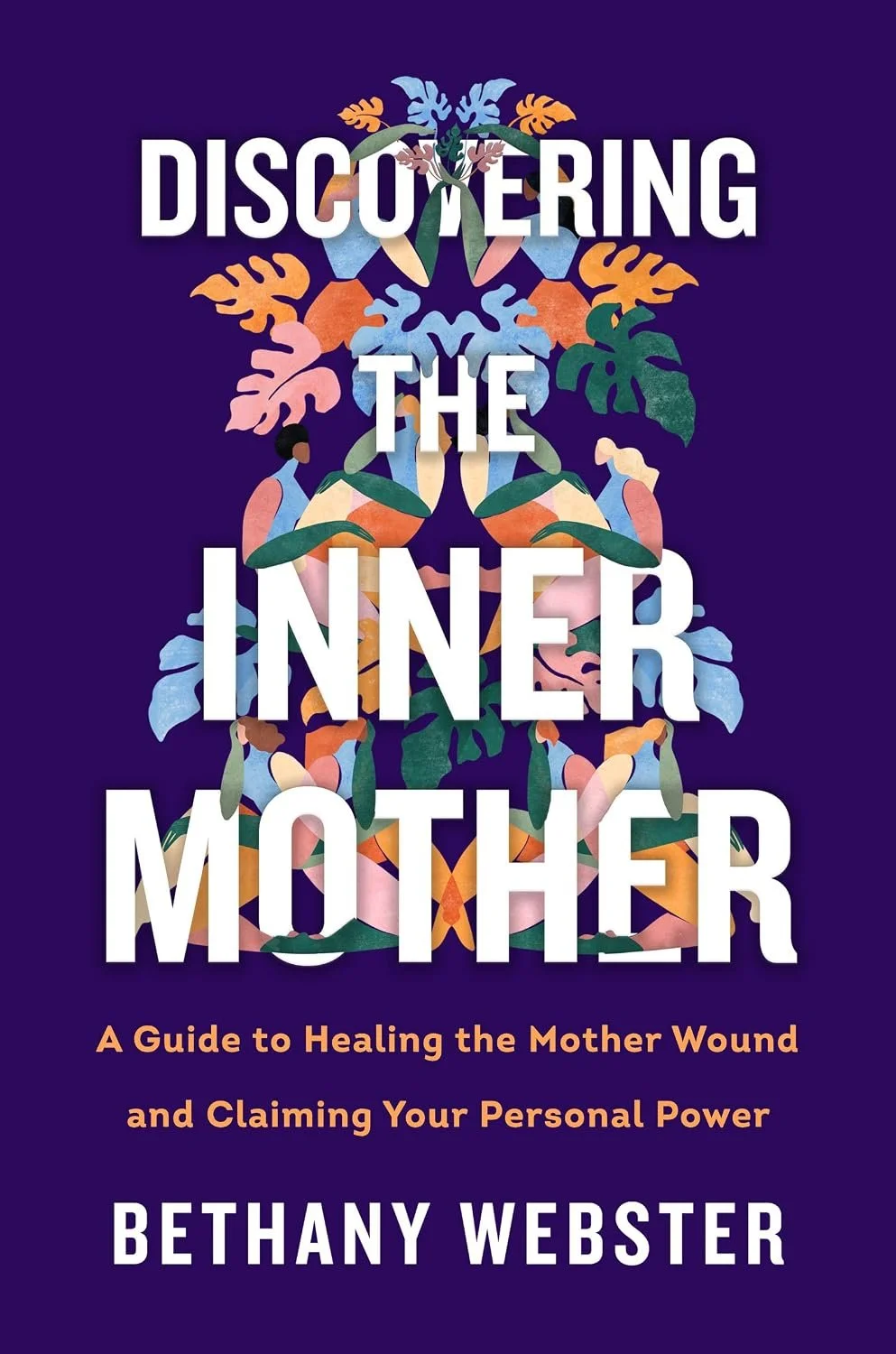
Discovering the Inner Mother: A Guide to Healing the Mother Wound and Claiming Your Personal Power by Bethany Webster
This book has taken me by storm. I can’t remember in what book I saw it recommended, but I can picture the page where I saw it in an author’s note. What I hadn’t figured on was how deftly the author credits patriarchy with its due in this hugely healing book.
Here’s the blurb:
Sure to become a classic on female empowerment, a groundbreaking exploration of the personal, cultural, and global implications of intergenerational trauma created by patriarchy, how it is passed down from mothers to daughters, and how we can break this destructive cycle.
Why do women keep themselves small and quiet? Why do they hold back professionally and personally? What fuels the uncertainty and lack of confidence so many women often feel? In this paradigm-shifting book, leading feminist thinker Bethany Webster identifies the source of women’s trauma. She calls it the Mother Wound—the systemic disenfranchisement of women by the patriarchy—and reveals how this cycle is perpetuated by wounded mothers who unconsciously pass on damaging beliefs and behaviors to their daughters.
In her workshops, online courses, and talks, Webster has helped countless women re-examine their lives and their relationships with their mothers, giving them the vocabulary to voice their pain, and encouraging them to share their experiences. In this manifesto and self-help guide, she offers practical tools for identifying the manifestations of the Mother Wound in our daily life and strategies we can use to heal ourselves and prevent our daughters from enduring the same pain.
In addition, she offers step-by-step advice on how to reconnect with our inner child, grieve the mother we didn’t have, stop people-pleasing, and, ultimately, transform our heartache and anger into healing and self-love.
Revealing how women are affected by the Mother Wound, even if they don’t personally identify as survivors, Discovering the Inner Mother revolutionizes how we view mother-daughter relationships and gives us the inspiration and guidance we need to improve our lives and ultimately create a more equitable society for all.
&&&&
Tony says that when I’m doing my work, the Universe always sends me to whatever I need, and after ten years together, I’ve decided his observation is spot-on. I didn’t know I needed this book for a whole other series that’s percolating in my brain, but now that I’ve read it, I sure did.
The most amazing thing is that the author, Bethany Webster, spent seventeen years in therapy, doing the work she so whole-heartedly recommends, and making sure she understood it enough—both in herself and as the process—to write about it cogently, urgently, and brilliantly. Truly. I highly recommend it, especially if you have any flags on the field of patriarchy.
&
Are you waiting for a sign?
How about this one?
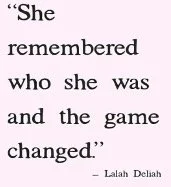
In a final honor to our
Belovèd Dolly,
we too need to find out,
or remember, who we are,
and do that on purpose,
because, when we do,
the game changes.
You’ll have to take my word for it,
but it really does.
Living from the deepest, most real,
authentic core of yourself
is the only way to have
a consistently fulfilling life.
So, please, if you haven’t yet,
make the time to find out
who you are,
DO IT.
Or if what you need is to
remember who you are,
make the commitment to it,
and make the time.
There is no worthier goal
than to find yourself and
do that on purpose.
That’s actually how we’ll
stand a chance
of healing the whole populace
and the whole planet.
And isn’t that a vital goal?
Thanks, Dolly, for all your help,
all your love, and all your music.
Good travels …
*For all the women who’ve been told all their lives that “man” means woman, too.
It doesn’t, gentlemen. This time, you do the translation.
&
I am, without doubt, certain that And is the secret to all we desire.
Let’s commit to practicing And ever more diligently, shall we?
Until next time,
Be Ampersand
&&&&
P.S. There have been some inquiries about donations and tax deductions. Sanctuary, the organization which umbrellas all of my work is a 501(c)3, and donations are fully tax deductible. Donate here using this address via Paypal. Or send a check snail mail to: Sanctuary, 16 Van Gaasbeck Street, Kingston, NY 12401.