
Ampersand Gazette #121
Welcome to the Ampersand Gazette, a metaphysical take on some of the news of the day. If you know others like us, who want to create a world that includes and works for everyone, please feel free to share this newsletter. The sign-up is here. And now, on with the latest …
&&&&
To Find Happiness, I Stopped Talking.
It Helped.

As happens for many people, my thirties were a decade of belated culminations: marriage, children, professional achievement (for me, the publication of novels and a teaching job). However, it all refused to settle into place. My wife and I struggled to get along. Parenthood was sometimes “all joy and no fun.” The novels received critical praise but sold modestly, and the teaching job was fifteen hundred miles from where my wife wanted, and continued, to live.
I didn’t know what would help, but I knew what wouldn’t: talking about it. I had spent two decades in and out of therapy, to some insight but little transformation. Ditto for the couples therapy my wife and I had undertaken. I felt ill from talking and noise.
So when, two years ago, an acquaintance mentioned to me an annual visit she made to a silent retreat, I cautiously probed for details. It was the antithesis of luxury, she said: an ecumenical contemplative Christian community in the middle of Georgia, with monastic quarters, silent meals and daily prayer, for sixty dollars a night. It didn’t even have a website.
I’m not a Christian, but I was desperate. I wrote to a monastic brother in the community, and we settled on several days that December. As the date approached, my thrill at the prospect of unspecified liberation turned to terror. I had never been alone with myself for that long.
I arrived to find a chapel and several modest residences bordered by fields for soybeans and hay. I was placed in a one-room cottage flanked by a statue of St. Francis and a lowland of sweet gums and broomsedge. I handed over my laptop and phone and, suddenly, there was nothing to do. I decided to go outside and, Georgia weather being generous even in winter, walk the soybean field. After I circled it, I kept going.
I was rediscovering the physical world—so this is what all those people meant by being present. That week, I sat with myself, in silence, far longer than I imagined I could. “The law of growth is rest,” as the British ecclesiastical artist Caryll Houselander once wrote.
Out in the world, I was always focused on the next move. Here, so little was necessary to feel not only content but ecstatic: simple meals that concluded with prayer and readings; fields to walk in the quiet and warmth; sincerity in the way I was asked after; acceptance when I dared to answer honestly. It had been a long time since anyone had looked me directly in the eyes.
In the desert of the self created by monastic silence, electronic detachment, and genuine fellowship, it suddenly seemed very clear that the main purpose of existence was love. I came home with ecstatic intentions of renewal. But I couldn’t make the retreat’s lessons work outside the retreat, where I was again overwhelmed by technology, parental duty and marital discord.
I attended the retreat for a second time last December. When I returned to my cottage, I reread parts of a memoir, lines about “the relief of not having to be anybody special” and instruction “in the art of being myself.”
I returned from the retreat with knit hats for the kids, handmade by Faye. When they are older, I will read to them from her book: “The soul-sized task of every small monastic community is to stand in the rubble and dream.” If they ever feel lost, I hope I am around to tell them that it may take time, but if their hearts are good, and their companions true, it might mean they are finally on their way to finding their way. They just need to fall silent, so they can hear themselves better.
Excerpted from an Opinion Essay by Boris Fishman in The New York Times
“To Find Happiness, I Stopped Talking. It Helped.”
August 1, 2026
Fall silent. Sit with those words for a minute.
We do, you know, fall into silence. The deepest silence there is, can be found at the end of an exhale. Try it. Exhale. That brief caesura, wherein you are not breathing in or breathing out is where silence resides within each of us.
How many, though, truly know this? And if we do, how many of us avail ourselves of its gifts?
Oh, we are a busy people, are we not? Busy. Busy. Busy. All the time. But most of that busy-ness is focused outside ourselves. Controlling (or attempting to,) managing, creating lists, and checking off items.
Are we that busy within? I don’t think so. But I do think that we avoid our own interiority with a vengeance. This, despite the fact that most of us know our happiness is an inside job. In fact, most everything of value is an inside job.
So why do we spend so much of ourselves managing what’s outside us, and avoiding our own inner landscapes? I think it has two causes. First, this is how we’re taught to live, to base our lives on the tangible—what we can see, hear, touch, taste, smell. Those are the measurable things. And does humanity love to measure.
Second, we have learned to approach our own inner worlds with trepidation. What will I find? How will I deal with it? What if I can’t? We’re also conditioned that we need a guide to approach our inner realities safely—a therapist, a guru, a priest.
None of that is true. But what is true is this quote, allegedly from Jesus, "If you bring forth what is within you, what you bring forth will save you. If you do not bring forth what is within you, what you do not bring forth will destroy you," from the Gospel of Thomas, Saying 70.
It is the assigned task of every soul on the planet to bring forth what is within you. It is what is within you that is a gift to the world, a gift that the world needs. The constant external focus we learn can be unlearned.
And you need not go to Georgia to do so. You can, each day, step away from your computer, silence your phone, close your eyes, fall silent, and retreat within to the deep silence that encapsulates your spirit, the true essence of you., that space in-between breaths.
Let go the constant doing. Let go the outer focus. Breathe. Touch the silence. Breathe. Let the silence touch you. Breathe. Be together, you and the silence. There is no greater gift you can give to yourself or the world.
&
The law of growth is rest.
British ecclesiastical artist Caryll Houselander
The Question:
How can I rest enough to grow?
&mpersand Answers:
Let’s start with the most obvious issue: do you actually rest at all? Very few of us do. Mostly what we consider rest is in fact distraction. Scrolling through social media. Binge-watching television.
Real rest is, uh, restful. Mostly it’s quiet, not silent necessarily, but quiet to be sure. Mostly it’s something only you can give yourself. Certainly no one else can rest for you, no matter that they try.
Real rest comes with a lack of stimuli. No screens. No jump-cuts. No sound tracks (unless making music is how you rest.) No noise.
Rest comes to most of us through stillness. We consciously slow the body, account for his or her aches and pains, release them, and sit, as in Don’t just do something, sit there.
Very good advice. Quiet. Stillness. No stimuli. Just you … being. That’s what will give you rest. And we so desperately need it—as individuals, and as a species. Most of the time we are exhausted.
Stop, Belovèd, just stop. Rest. Let go all your plans, your worries, your woes, your cares. Rest. There is a perfect psalm (46:10) for this: Be Still, and Know that I am God. You are, as am I. And God knows how much and when you need to rest in order to grow.
&
Here’s a universal affirmation. It works every time, for everyone, always and forever …

This has been my bottomline prayer for years, especially when I’ve hit my wits’ end.
&


I’m back in it with Betrayed, Book 2 of Prismatica.
One of the things I’ve realized is that I’m rewriting historical years that I myself lived through. In 1983, I was up to my eyeballs on Broadway, working as a producer’s assistant. Little Shop of Horrors, the show I was Assistant Company Manager on, had opened the previous year. It was the first foray of the Shubert Organization, the leading theatre owner of Broadway properties then and now, into Off-Broadway. At the time, it was a huge hit.
A friend of mine had a similar position to mine for that most infamous flop Moose Murders. I saw it. Correction: I sat through it. Both acts. When I got home, I left my friend a message: “I have two words for you,” I said. “John Simon.” I knew it would make him laugh.
John Simon was then theatre critic for New York Magazine, and his reputation for blistering reviews preceded him. If I remember correctly, and I do, his caustic prose stood in a queue of dreadful pans. John Simon was the least of it.
It’s fun to revisit my own history on one level, and it’s devastating on another. That was also the era in which I could go to a meeting on Friday, and see a man there, and attend a similar meeting on Monday only to learn that the young man had died over the weekend. HIV/AIDS was a real and present danger to those I loved.
Remembering the beginnings of Mex put me in deep longing to be writing her again. No real surprise there, is it? Her series is sort of the flagship series of my fiction career. Mex solves mysteries. Strange ones.
All of them happen around a theatrical production of a musical nature. Each one has the solve of the murder in the lyrics of the show. Every book takes on a social justice issue. Mex and her team listen within to follow their intuition and solve a case. She’s never not solved one. Never.
If someone had told me, lo, those many years ago, that I’d still be writing Mex to this day, I’d have laughed in their face. That voice I heard? It was 1997. My mom was still alive, and so was my bestie, Kenneth.
My mom got to read Oklahoma! Hex. For a long time, I kept her handwritten notes on the manuscript, till long after she’d died. I hung onto them because I treasured that she’d seen it and read it. Kenneth died two years later, and before he died, he chose his character name. It’s one of the ways I’ve used to feel his loss in my life less, and to keep his wicked good humor alive.
Book Eleven is called Shrew This! and it takes place during the Covid-19 shutdown. Anchored in an all-female production of Taming of the Shrew presented by the residents of a safe-house shelter, it addresses intimate partner violence. The spiritual healing modality is the use of mandala, one of my favorite methods for calming my nervous system. Coloring. Seriously. This is the first Mex based on a play, not a musical, although, for inquiring minds, there is a Shrew musical. It’s called Kiss Me, Kate.
&
Please make this indie author happy. Choose one of my series, and read all of them. Then review all of them. That’s the way others find books.
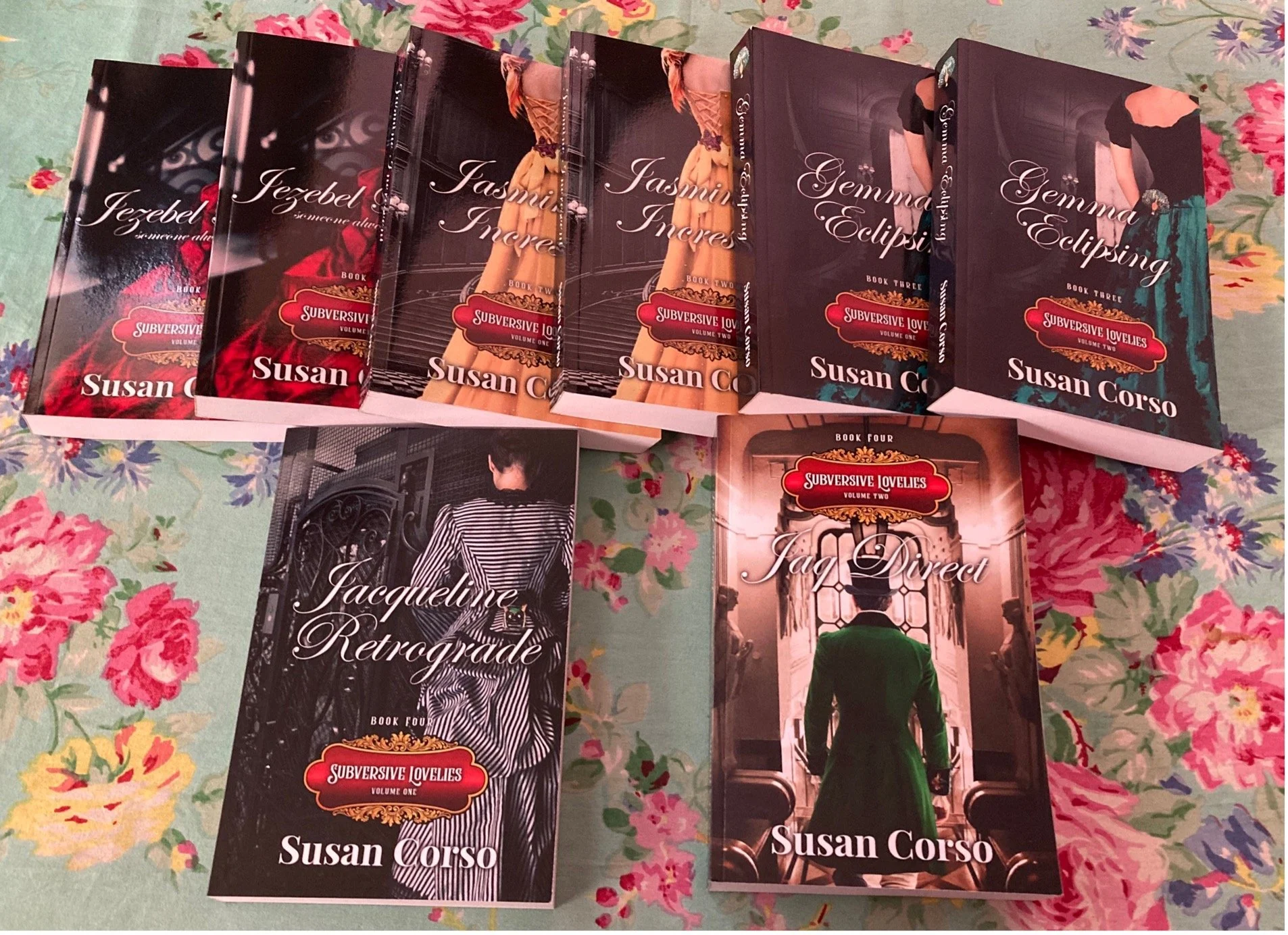
You could start with The Subversive Lovelies—the stories of four siblings in the Gilded Age who just cannot manage to follow the rules! Or The Mex Mysteries … the first one is Oklahoma! Hex. And there are eleven of them Or, one of the five Boots & Boas Butch-Femme Romances … perfect summertime reading. Or, please, be my guest! There’s always the option of starting with one series and reading them all! That’s what I do when I fall in love with an author.

&

With all the hoopla around A.I. and what constitutes “real writing,” my editor (and, true confessions: spouse) is a beacon of sanity. A.I. is an ‘oooh sparkly’ right now. All the cool kids are using it.
Tony says, “People are going to use A. I.. The issue isn’t whether we are or not; the issue is how we’re using it.” For someone who has been coaching and nurturing queer writers for more than thirty years, that’s a pretty measured response.
It’s one of the things that I treasure in Tony’s work on my books. If I want to try something completely outré, he never naysays me. Instead, he tells me to go ahead and try it, and we’ll work with it.
Does your writing need reflection from just such a measured source? Do you long for a safe space in which to try something totally wild in one of your stories? This is the guy, I promise you. Find Tony Amato here.
&

The Gay Metropolis: The Landmark History of Gay Life in America by Charles Kaiser
As a general rule, I tend to read fluff in the evenings—for a brain break, and nonfiction or research material during the day. This one is a daytime reader. I happened upon it, and realized it would be helpful for Prismatica
Here’s the blurb:
Now featuring an updated introduction commemorating the 50th Anniversary of Stonewall
A New York Times Notable Book of the Year and winner of a Lambda Literary Award, The Gay Metropolis is a landmark saga of struggle and triumph that was instantly recognized as the most authoritative and substantial work of its kind. Now, for the fiftieth anniversary of the Stonewall uprisings, Charles Kaiser has brought this history into the twenty-first century. In this new edition he covers the three court cases that lead to the revolutionary legalization of gay marriage in America, as well as shifts toward inclusion in mainstream pop culture, with the Oscar-winning films Brokeback Mountain and Call Me By Your Name.
Filled with astounding anecdotes and searing tales of heartbreak and transformation, it provides a decade-by-decade account of the rise and acceptance of gay life and identity since the 1940s. From the making of West Side Story to the catastrophic era of AIDS, and with a dazzling cast of characters―including Leonard Bernstein, Montgomery Clift, Alfred Hitchcock, John F. Kennedy, and RuPaul―this is a vital telling of American history.
* * *
The book starts in the 1940s with a bifurcated world of queer men. There were the Park Avenue gays, the ones no one ever suspected, and the Times Square gays, the ones in the silver lamé dresses (suspicion unnecessary.) One of the Park Avenue types was a man named Richard Barr. Not significant except that the more I read, the more familiar he sounded. Turns out, I knew the man. He was a prolific Broadway producer, and his office was next door to ours.
&
Are you waiting for a sign?
How about this one?

This is an image of the
Mini from The New York Times.
MANNA
is a very special word in Scripture.
You can tell because it hasn’t
been translated into English,
at least in English-language editions.
A friend once asked me to do a
Big Favor
for a Rabbi he knew.
I was glad to do the deed.
My friend wanted to know how
I would like to be compensated.
I said I’d like to meet the Rabbi,
and ask one question.
Now this was a very Orthodox Rabbi,
and questions from women, not to say
audiences with women who weren’t
one’s lawfully-wedded spouse,
were a rarity indeed,
but the Rabbi agreed to my terms.
My friend was appalled.
When I met with him, I asked,
“What does manna mean?”
I’d been asking for a long time,
and no one had given me a satisfactory answer.
The Rabbi twinkled at me,
“Such a good question,” he said,
his Old Country accent rich.
“Manna, my dear,” said the Rabbi,
“means what is.”
Look around your life right now.
Where’s your manna?
Let’s have a moment of appreciation
for manna in all its magical disguises,
because we are blest with
what is when we appreciate it.
&
I am, without doubt, certain that And is the secret to all we desire.
Let’s commit to practicing And ever more diligently, shall we?
Until next time,
Be Ampersand