
Ampersand Gazette #112
Welcome to the Ampersand Gazette, a metaphysical take on some of the news of the day. If you know others like us, who want to create a world that includes and works for everyone, please feel free to share this newsletter. The sign-up is here. And now, on with the latest …
&&&&
The Emptiness of the Universe Gives Our Lives Meaning

I’m a cosmologist. I have spent my career researching one special part of the universe called cosmic voids: the vast expanses of nothing that stretch between the galaxies. I have spent years working to understand what cosmic voids teach us about the wider universe and its history.
Yes, the universe is mostly void, but we have found many wonders in those great expanses. The voids don’t simply exist; they define and provide contrast to the galaxies that surround them. The properties of the voids reflect the mysterious forces that govern the evolution of the universe.
Earth is still the only known place in the entire universe where conscious beings raise their curious eyes to the sky and wonder. Earth is the only known place where humanity exists—where humanity can exist. It is the only known place where laughter, love, anger and joy exist. The only known place where we can find dance, music, art, politics and cosmology.
Our disagreements and jealousies and all the beautiful complexities that make us human aren’t meaningless. The presence and dominance of the cosmic voids guarantee the opposite—the stories and experiences we fill our lives with are special precisely because they will never happen in the empty expanse of most of the universe.
I have learned that the same lessons that cosmic voids teach us are found in the voids we encounter in our own lives. Voids sharpen and define; they create contrast; they are full of potential. The pain we feel from loss is the last reminder of the gift of a life deeply loved. The silence before a performance begins is sparkling with electric anticipation.
Artists and philosophers have long understood the power of the void. The 12th-century Buddhist monk and poet Saigyo reflected on the gaps between falling raindrops, noting that the pauses between their sounds were just as important as the drops themselves, if not more so. The composer John Cage challenged us with “4ʹ33ʺ,” a performance consisting entirely of silence, creating a manifestation of the void that audiences sought to fill with awkward coughs and nervous laughter, which became its own music. The famed Dutch architect Rem Koolhaas celebrated the utility of negative spaces, proclaiming, “Where there is nothing, everything is possible.” For the psychoanalyst Carl Jung, the void was a psychological space that we must enter to realize our full potential and forge a new life.
The implacability of the cosmic voids calls us to action. The universe won’t do anything for us except give us the freedom to exist. What we do with that existence is entirely up to us. It is our responsibility to imbue the cosmos with meaning and purpose.
Excerpted from an Opinion Essay by Peter M. Sutter in The New York Times
“The Emptiness of the Universe Gives Our Lives Meaning”
November 3, 2025
Most of us know at least one person who simply cannot stand emptiness—any emptiness, including silence. They so fear the void that they will do anything to fill it. What a loss.
The fear of the void is a patriarchal installation across our species. It is the fact that is missed out in most scientific explanations of our universe, including those of cosmologists.
Unafraid to attribute gender to what is, they refuse to attribute gender to, if you will, what isn’t.
The first two verses of Genesis read:
In the beginning God created the heaven and the earth.
And the earth was without form, and void; and darkness was upon the face of the deep. And the Spirit of God moved upon the face of the waters.
Please notice just how many voids there are: three, to be precise about it.
Earth without form
Void
Darkness
These three emptinesses have to be somethings, and not nothings, because they are … wait for it … “upon the face of the deep.”
Whoa. Wait, what?
What the hell is the deep, and why do we just gloss over that part?
Here’s why: the redactors couldn’t figure out how to leave it out, so they left it in, and DID NOT EXPLAIN IT.
The original Hebrew word for the deep, tehom, is a feminine noun. Which is why so many patriarchal dogmas gloss over it.
The deep, that very same tehom, is the sacred feminine space in which creation happens, the cosmic equivalent of a womb.
And what is a womb? A deep? A sacred space in which alchemical mystery occurs.
Yes, without form—to begin.
Yes, void—to begin.
Yes, dark—to begin.
All of creation—from the cheesiest limerick to the worst pun to the most sublime symphony and the transcendent musical—needs a sacred space in which to germinate, grow, and from which to be born.
This is that deep, that tehom, that wondrous place wherein everyone is a creator.
We gloss over it. We mislabel it. We diminish it. At. Our. Severe. Peril.
It is just such a necessary void that frees each one of us to create meaning for ourselves and for our world. And isn’t that quite the awe-worthy blessing?
&
Law and justice are not always the same. When they aren't,
destroying the law may be the first step toward changing it.
Gloria Steinem, activist, author, and editor
The Question:
How can I best participate in justice?
&mpersand Answers:
Oooh, isn’t this a doozy of a question! First, are law and justice the same? I’m with Gloria Steinem. They’re not.
Not only that, but I’ll go out on a limb here and say that law is the practice that is supposed to enact the theory we know as justice.
Everyone knows that law is a practice, that lawyers learn to be lawyers, that they practice law, and that, on occasion, it’s good to have one or know one or both.
Justice, on the other hand, is an entirely different entity. It’s impartial by its nature. That’s why its personification is Blind Justice.
And here is where we imperil ourselves when we meddle.
We love to think that we know what constitutes justice in any situation, but justice isn’t an opinion, or a feeling, or a hunch even. Justice, like gravity, simply is. It has no personal component.
So the first way to participate in justice is to open your mind, and the second way is to open your heart, and the third way is to commit to stick with whatever process it takes to get to justice via human interaction, no matter how attenuated or frustrating or both.
Law likes to make short shrift of what’s fair and what’s not.
Justice likes to chew an issue over slowly, sleep on it, chat some more, and then decide what’s right.
Law is fast. Justice is slow. Law can be changed, but justice, real justice changes the world. Always for the better.
&
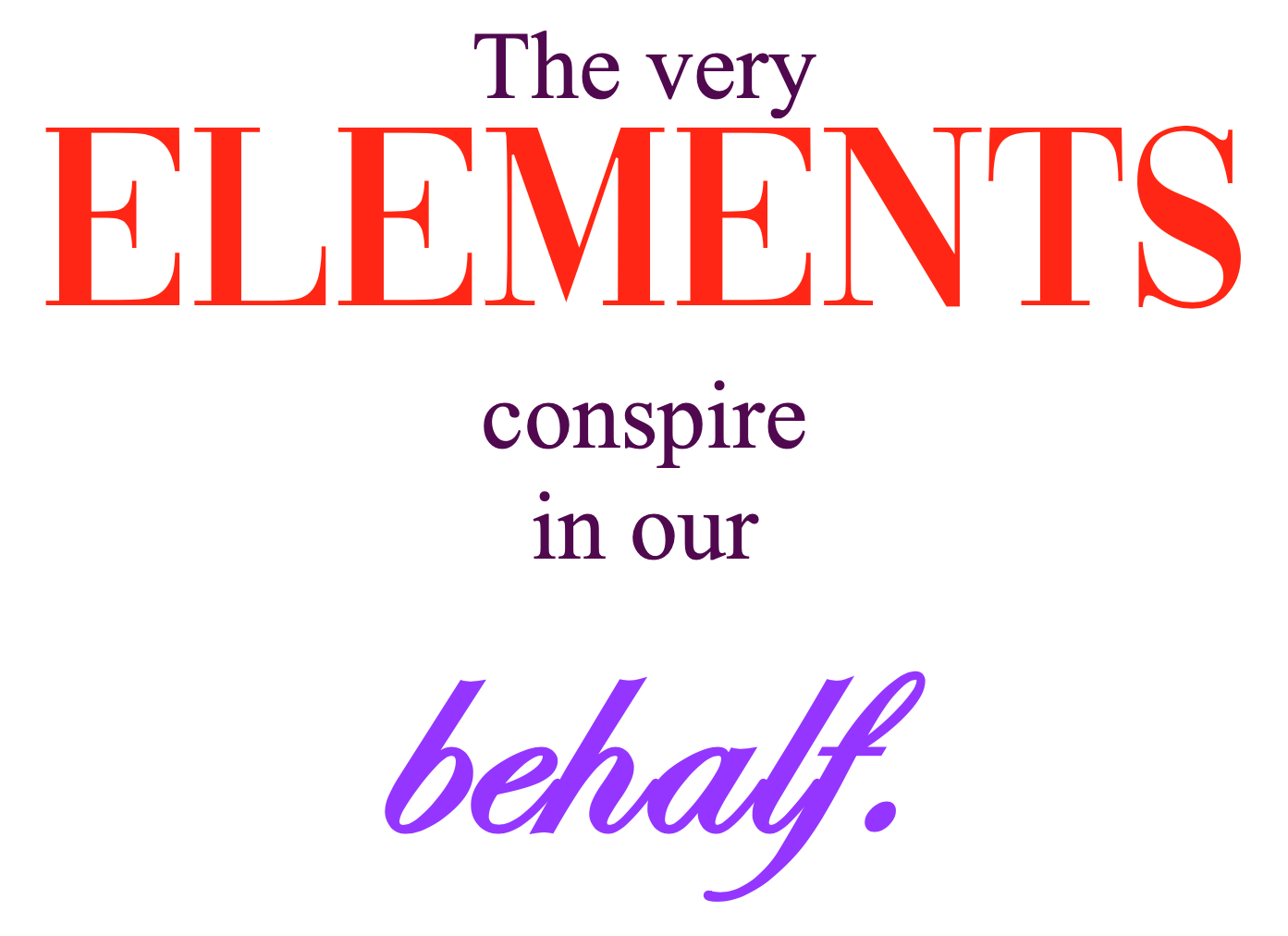
Here’s a universal affirmation. It works every time, for everyone, always and forever …
&

Still in world-building mode, but also getting clearer as each day goes by. That’s a relief, although whilst I am in the midst of the process, it seems molasses-in-January slow.
I finally understand something vital about my research process. I start at the widest end of a funnel, researching far and wide, no holds barred. As time (and experience) lead me, I advance into the narrowing of the funnel until what I am seeking is specific. Then, once I find whatever that is, I start all over again for the next piece of research. It’s a great image as it keeps me focused on momentum, and not feeling (different from being) stuck.
As for the recording studio, I’m doing a little bit every day, and just like Alice since I began at the beginning, and am going on, when I get to the end, I will stop. I’m still fixed on not the perfect of an audiobook, instead the imperfect of a bedtime story read aloud.
I’ve pretty much decided, or, really, I’ve been guided, to prepare to write two books at the same time again—a perfect way to recover from major surgery. Book 2 of Prismatica, as above, and the eleventh Mex Mystery. It’s called Shrew This! and it takes place during the Covid-19 shutdown. Anchored in an all-female production of Taming of the Shrew presented by the residents of a domestic safe-house shelter, it addresses intimate partner violence. The spiritual healing modality is the use of mandala.
Please make this indie author happy. Choose one of my series, and read all of them. Then review all of them. That’s the way others find books.
The entire series of The Subversive Lovelies is one option. Fall into the stories of the four siblings who just will not follow the rules of society.
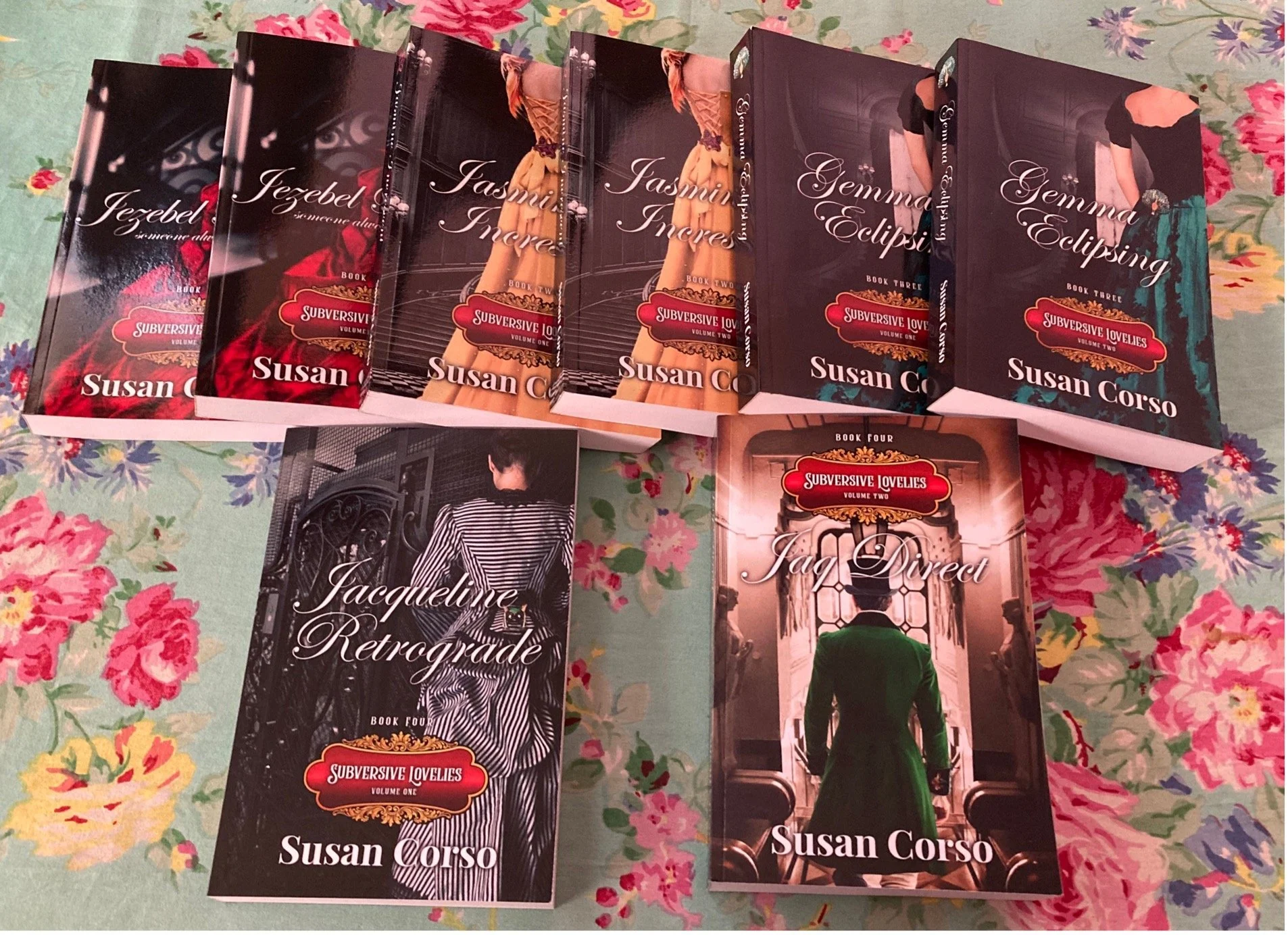
I just got the first (stellar!) review of Jaq Direct. Scroll down to find it here.

&
Special Request:
Send me your spiritual questions please. As of now, which I’m sure you’ve noticed, I’m posting &mpersand Answers twice a week.
&
Having someone fully present and accounted for in holding your creativity is as important as oxygen as far as I’m concerned. Without a container, my creative self can go off in hare-brained directions, down rabbit and mole holes, and over the river and through the woods without notice. I don’t think I realized this until I had it in my life, and only then did I figure out what the lack of it had meant.
It’s similar to the essay at the head of this issue of Ampersand Gazette. The space in which things happen needs to be safe, and held by a reliable sort.
Enter Tony Amato, stage left.
The gift of a writing wizard along for the ride—from tentative conception to holding a finished book in your hands—is inestimable. I’ve seen writers who were determined to give up become re-enthused because of Tony’s guidance. I’ve seen writers who were world-class procrastinators sit their butts down at the page and knock out a manuscript. And all sorts in between.
Is it time you invested in your writing? Tony Amato is a full service, one-stop shop. He’s helped more LGBTQ+ authors, as well as others, get clear on the best way to tap into their creativity, discern their own processes, learn their craft, and come up with stellar projects. Find this genius—yes, I’m saying it, who has been nurturing authors for more than thirty years, here.
&
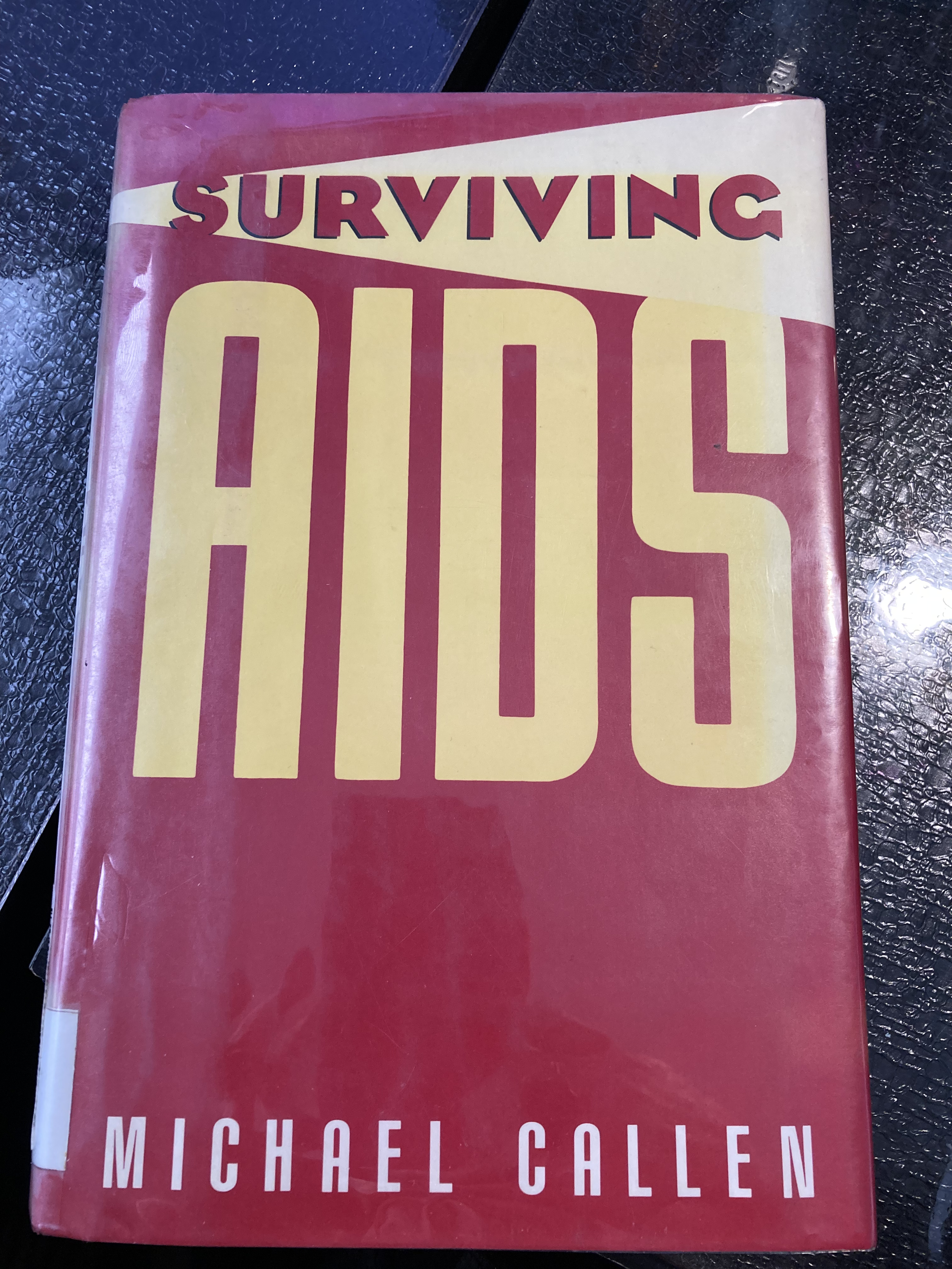
Surviving AIDS by Michael Callen, Published January 1, 1990
from the dust jacket …
In 1982, the year Michael Callen was diagnosed with AIDS, his prognosis was grim. Most doctors believed that no one survived AIDS for much longer than a year. But eight years later, Michael is one of hundreds of long-term survivors who are still alive and doing fine.
In fact, Michael is doing so fine that he’s testified before Congress, produced a record album, self-published a magazine, co-created People with AIDS Coalition (an organization that offers counseling, financial services, and social activities to those diagnosed with AIDS,) and co-founded the Community Research Initiative, a community-based organization that tests promising drugs to fight AIDS.
Probably the greatest myth about AIDS is that it’s always fatal, an automatic death sentence. With Surviving AIDS, Michael fights against the public ignorance and sloppy reporting that have created this damaging lie. He tells both his own story and, through in-depth interviews, the stories of thirteen other long-term survivors.
A profound and moving book, Surviving AIDS profiles men and women, gay, straight, and bisexual, black, white, and brown, each of whom is living a remarkable life. These are stories of their fighting spirit, their courage, their drama, and their sometimes outrageous sense of humor, and present their answers to the question: “Why am I alive?”
I read a lot of out-of-print books.* A lot. The reason is because a lot of my books take place not in current time, so I research like a fiend. Then I narrow down what I need to lend authenticity to the era in which I’ve placed my story.
Michael Callen is a hero. Whether you agree with his AIDS philosophy or not, he stood up for what he believed. He acted on it. He was articulate as all get-out. In the years during which he became a long-term survivor (meaning lived over three years with a certified diagnosis,) he did everything in his power, and used every resource he had, to help change the narrative of HIV/AIDS for all time.
*Abebooks.com is my go-to for used books; their service is great.
&
Are you waiting for a sign?
How about this one?

Let’s play out a fantasy,
shall we?
What if you came across a
magical book,
and opened it
only to discover
that you had at your disposal
An Energy Dragon
to send wherever you wanted,
to do whatever you wanted?
We love to moan about the
State of Our World,
so here’s your chance.
FIX IT.
CHANGE IT.
HEAL IT.
Use your Energy Dragon
for good, Belovèd.
Where would you send it?
&
I am, without doubt, certain that And is the secret to all we desire.
Let’s commit to practicing And ever more diligently, shall we?
Until next time,
Be Ampersand